By NuaSense, based in Nairobi

Get soil sensors for your farm in Kenya

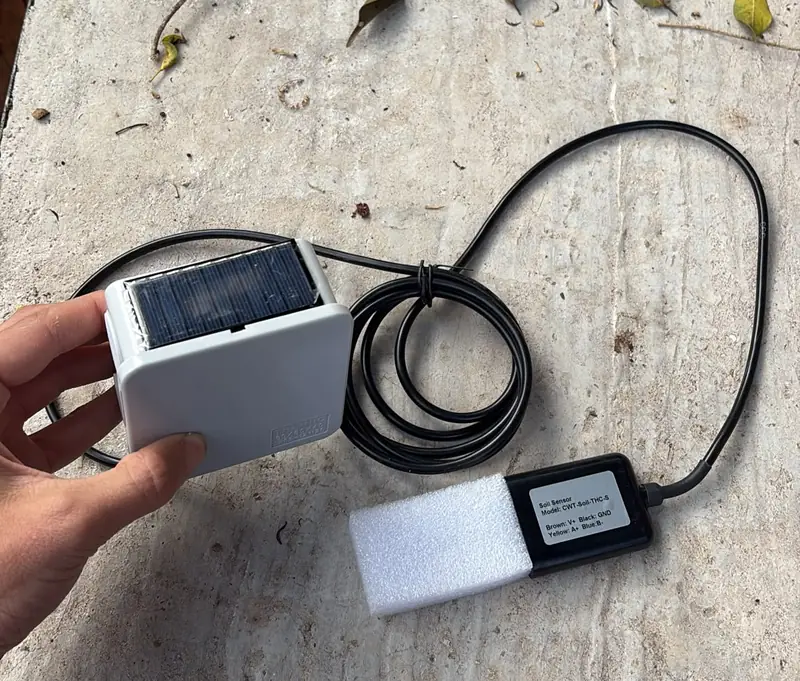
Each sensor reads soil moisture and soil temperature in the root zone about every 10 minutes. A solar powered node box sends the readings to your NuaSense weather station, and from there to your phone.

A NuaSense node box with its small solar panel on top, held in one hand, and the soil sensor on its cable in front of it

What a NuaSense soil sensor measures, and what it does not

A soil sensor answers one question well: how wet and how warm the soil is where the roots are, today and over the past weeks. It does not test fertility, and it does not need to.

Soil moisture

Relative moisture in the root zone, reported as a percentage of the sensor's own scale. You watch it rise after irrigation or rain and fall as the crop draws water, and you irrigate on that trend instead of the calendar.

Soil moisture sensor
Soil temperature

Every sensor also reads soil temperature at its depth. Germination and root growth follow the temperature of the soil, not the air above it, so the reading at seed depth is the one that counts at planting.

Soil temperature sensor

EC, the salt load

The EC version adds electrical conductivity, which rises with the salts dissolved in the soil water, from fertiliser and from irrigation water. Read over weeks, it shows salt building up under drip or fertigation.

Soil EC sensor

What it does not measure

Nitrogen, phosphorus, potassium and pH. For fertiliser and lime decisions you need a lab test of your soil, and no in-field sensor replaces it (why a pH meter and the lab disagree). The NuaSense dashboard does show soil texture, pH and water holding capacity for your location, but those are modelled map values from iSDA Africa and SoilGrids of around 2016: useful background, not a test of your field.

Soil sensor prices in Kenya

These are the only prices we publish, in Kenya shillings and excluding taxes. The sensors need a NuaSense weather station to come online, so a farm starts with one station and adds a sensor for each block it wants to watch.

NuaSense soil sensor and weather station prices, excluding taxes
What you buyWhat it readsPrice, excl. taxes
Soil sensor, one depthSoil moisture and soil temperatureKES 7,000
Soil sensor, two depthsTwo moisture and two temperature channels, a shallow and a deeper readingKES 9,000
Soil sensor with ECAdds electrical conductivity, the salt load of the soil waterKES 10,000
NuaSense weather station RequiredRain, wind, air temperature, humidity, air pressure and sunlight. It also brings the soil sensors online.KES 30,000

Want more than two depths at one spot? The node box takes more sensors; ask us for that price.

Running costs

Mobile data

The station connects over a Safaricom SIM. We pass the data fee on at cost, typically about one US dollar per station per month. On Wi-Fi there is no data fee.

Dashboard

Included at no charge, with five direct downloads a day, on the NuaSense dashboard.

Alerts

SMS and WhatsApp alerts cost 0.03 US dollars per message. Switch them on or off, or change how often they come, at any time.

API

Only if you want the readings inside your own system: one US dollar per 1,000 calls. Using the dashboard costs nothing.

  • Pay one month after the station is installed and transmitting
  • 100 percent money back within the first three months
  • Six-month warranty on the purchase price, covering all damage you did not cause

How the readings reach your phone

Two pieces of hardware do the work, and no cable runs between the field and the station.

  1. Sensors in the root zone

    Each sensor sits on its own cable at the depth you choose for the crop. One node box carries one sensor or several, so a single spot can be read at two or more depths.

  2. A node box with its own solar panel

    The box charges from the small solar panel on its lid, holds a battery and can also be charged over USB-C. It needs no mains power and no battery changes.

  3. LoRaWAN radio to your weather station

    About every 10 minutes the box sends its readings by LoRaWAN radio to your NuaSense weather station, which measures the weather at the same time. There is no other receiver to buy.

  4. Online over a Safaricom SIM or Wi-Fi

    The solar powered station carries soil and weather readings to the internet on its own, over a Safaricom SIM card or over Wi-Fi where you have it.

  5. Dashboard, alerts and API

    You read soil and weather side by side on the dashboard, get SMS or WhatsApp alerts when you want them, and can pull the readings into your own software through the API. See how the whole system fits together.

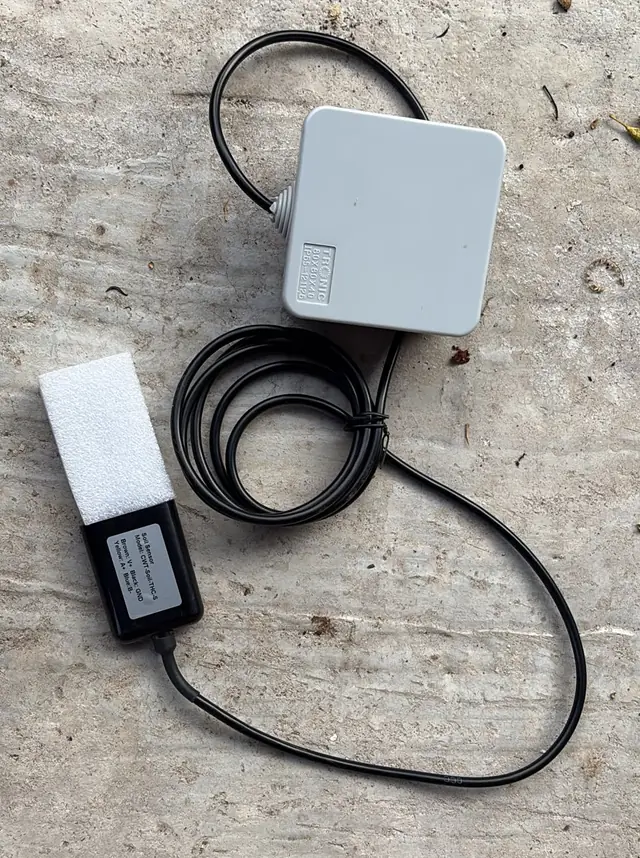
A NuaSense node box seen from above with its coiled cable and the soil sensor, its pins protected by white foam
One node box, its cable and a sensor, as they arrive. The foam protects the pins until the sensor goes into the soil.

Reading the numbers: percent of scale, field capacity and depth

The moisture figure is a percentage of the sensor's own scale, not the volume of water in the soil. Readings between 60 and 85 are normal on that scale. The scale follows wetting and drying faithfully. What it cannot tell you on the first day is which number means full for your soil (percent of scale or volumetric water content).

That number is your field capacity, and you find it once, on your own field. Soak the soil around the sensor, let it drain, and note the reading when it stops falling quickly. From then on you irrigate when the reading has dropped a set distance below that mark, and you stop when it comes back. The full method is in how to calibrate a soil moisture sensor on your own field, and the three numbers you need to read a moisture reading puts field capacity, wilting point and depletion side by side.

Depth matters as much as the number. The shallow sensor shows when the crop has started drawing water and it is time to irrigate. The deeper sensor shows whether the water reached the bottom of the root zone, or whether you are pushing it past the roots. There is no single correct depth, because it follows the crop and how deep its roots go, so we never print one as a specification (how deep to bury a soil probe, and why two depths beat one). Each crop also wants its own range, which you can read off the probe crop by crop.

Soil temperature comes from the same spot. It tells you when the seedbed is ready and what mulch does to the root zone, and in most of Kenya it is moisture rather than cold that holds germination back (soil temperature and germination).

Soil sensor, handheld meter or lab test: which one answers your question

Search for a soil sensor in Kenya and you find KES 150 circuit boards next to KES 85,000 testers. They answer different questions, and the right one depends on the decision you need to make.

Ways to judge soil moisture and soil condition, with typical prices in Kenya
ToolWhat it tells youTypical price in KenyaWhen it fits
Hobby sensor moduleA raw signal for your own electronics project, with no logging, power or connectionKES 150 to 900Learning and prototypes
Handheld soil meterOne spot at one moment. Some testers also show NPK figures; for fertiliser decisions a lab test is the referenceKES 1,200 to 7,000; professional and NPK testers KES 12,000 to 85,000Spot checks across a field
Lab soil testNutrients, pH and organic matter for one sampleKES 1,000 to 5,000 per sampleFertiliser and lime plans, once a season
NuaSense soil sensorMoisture and soil temperature in the root zone about every 10 minutes, EC on one version, with alertsKES 7,000 to 10,000 per sensor plus the KES 30,000 station, excl. taxesIrrigation decisions every week

Third-party prices are typical figures from Kenyan shops and lab price lists in October 2026.

On an irrigated farm the lab test and the sensor do not compete. The lab test sets the fertiliser plan once a season; the sensor times the water every week.

Irrigation and salinity decisions the readings support

Readings earn their money when they change what you do this week. These are the decisions farmers make with them, each explained in our Field Notes.

When to start and stop irrigating

The shallow sensor shows the crop drawing the root zone down; the deeper one shows when the water you applied has arrived. Between the two lies your irrigation window, and it differs by crop: the soil moisture range each crop wants.

How deep the first rains went

After the first showers the shallow reading jumps while the deeper one stays flat until the layer above it is full. That tells you whether the rain reached the roots or only wet the surface: how deep the first rains wet the soil.

When standing water starts costing yield

Waterlogged soil runs short of air, and some crops are most exposed at early growth stages. A sensor that stays at the top of its range after rain is the signal to open the drains: how fast standing water starves roots of air.

When the seedbed is ready

Planting rules written for colder countries wait for a soil temperature threshold that Kenyan soil usually passes early. The sensor shows temperature and moisture at seed depth together, which is the pair that decides emergence.

NuaSense sells the sensors and the data service around them, not pumps, valves or pipework. If your irrigation controller takes outside data, the API can feed it the readings. Nothing on this page is a forecast: every decision rests on what the instruments recorded.

From order to first reading

This is the whole process, from the first message to the first reading on your phone.

  1. Tell us about your farm

    Send your crop, the number of blocks and how you irrigate, on WhatsApp or with the form below.

  2. Get a setup and its price

    We reply with how many sensors you need, at which depths, and the station that brings them online.

  3. Install the sensors yourself

    Each sensor goes into the soil at the depth your crop needs, and the node box stays above ground where its solar panel gets sun. Message us if anything is unclear.

  4. Watch the first readings arrive

    Once the station is installed and transmitting, readings appear on your dashboard about every 10 minutes.

  5. Pay a month later

    Payment falls due one month after the station is installed and transmitting. If the system does not work out for you, you get all your money back within the first three months. Place of fulfilment: Kileleshwa, Nairobi.

Who soil sensors pay off for, and who should skip them

Worth it

  • Irrigated vegetables, fruit and flowers, where a missed or wasted irrigation costs real money
  • Greenhouses on drip or fertigation, where EC matters as much as moisture
  • Farms with several blocks of different soil, slope or crop, each drying at its own pace
  • Anyone deciding every week when to irrigate and for how long

Skip it

  • A single rain-fed plot where no decision changes with the reading
  • A one-off question that a spade or a handheld meter answers in a minute
  • Fertility questions: nutrients and pH need a lab test, not a sensor

Not sure where your farm sits? Our sister site works through whether a networked sensor system pays off for your acreage.

NuaSense Platform

The most comprehensive agricultural live dataset in East Africa

Your sensors read one field. The platform reads everything around it: 31 datasets over a single key, spanning farm telemetry, satellite, climate and market across four East African countries.

Live catalogue platform.nuasense.com
  • County input prices DAP, urea, CAN, NPK, MOP and TSP in KES per kg: official medians beside marketplace asking prices. 29 counties · 5 yr
  • Satellite demand Cropland NDVI read against each unit’s own seasonal normal, never a national average. 243 units · 8 yr
  • Import & trade flows Monthly customs flows: origin countries, volumes, unit cost, and landed cost against local retail. 4 countries · monthly
  • Daily news signals East African agriculture reporting read every day and extracted into structured, source-traceable signals. 23 commodities · daily
  • World benchmarks Global fertiliser prices in $/mt, the import-cost direction behind every local move. global · monthly
Soil readings from your own field Readings from the sensors on this page stream into the same key, beside the market layers above. Your station

Questions farmers ask about soil sensors

How much does a soil sensor cost in Kenya?

A NuaSense soil sensor costs KES 7,000. The version with two moisture and two temperature channels, for two depths, costs KES 9,000, and the version that also measures EC costs KES 10,000. The sensors come online through a NuaSense weather station, which costs KES 30,000. All prices exclude taxes.

Do I need a weather station for the soil sensors?

Yes. The soil sensors send their readings by LoRaWAN radio to the NuaSense weather station, and the station carries them to the internet. The same station measures rain, wind, air temperature, humidity, air pressure and sunlight, so there is no other receiver to buy.

How is the soil sensor powered?

The node box that carries the sensors has its own small solar panel and a battery, and it can also be charged over USB-C. It needs no mains power and no battery changes in the field. The weather station is solar powered too.

Do I install the sensors myself?

Yes. Farmers install the sensors themselves, and it is easy: each sensor goes into the soil at the depth you choose, and the node box stays above ground where its solar panel gets sun. Message us on WhatsApp if anything is unclear.

How many soil sensors do I need?

Count blocks, not acres. A block that differs in soil, slope, crop or irrigation line dries at its own pace and needs its own sensor, while blocks that behave alike can share one. Send us your block layout and we will suggest how many sensors you need and where they go.

Can a soil sensor measure NPK or pH?

Ours does not. It measures moisture, soil temperature and, on one version, EC. Nitrogen, phosphorus, potassium and pH come from a lab test of your soil. The NuaSense dashboard shows modelled soil texture, pH and water holding capacity for your location from iSDA Africa and SoilGrids maps of around 2016. That is background, not a soil test.

Ask what a setup on your farm would look like

Tell us your crop, how many blocks you farm and how you irrigate. We reply with the sensors and depths we would use, the station that brings them online, and the price.