How deep you set a soil probe is a one-time call you make with a spade, then live with all season. Set it too shallow and all it reports is the last shower, not the roots. Set it too deep and it reports water the crop may never reach. As a measurement, neither depth is wrong. As an answer to your real question, both miss it: does the root zone hold water?
Start with what the evidence actually says. No source in front of us gives a burial depth for a probe in any Kenyan crop, and this piece will not invent one. What exists is international extension guidance on placing moisture sensors and soil samples, one compaction trial from the United States, and a Kenyan study on erosion. The job is to take those sources, say where each was measured, and reason about what changes on a Kenyan block.
Measured by NuaSense weather stations and soil probes on Kenyan farms, over the period stated with each figure. Past readings, not a forecast.
The root zone sets the depth, not a number of centimetres
The Iowa State extension guide to evaluating soil moisture in the field offers a rule of thumb for gypsum blocks: one block per 1 foot of soil depth inside the active root zone. It also notes that how many blocks you need per station depends on how deep that root zone runs, and that varies by crop. That is the useful part. The rule does not give you a depth. It gives you a method: find the active root zone for your crop, then cover it.
Iowa guidance was written for annual row crops in a temperate climate. The logic carries over to a Kenyan block. The numbers do not. A shallow-rooted vegetable under drip and a deep-rooted maize crop on a ridge call for different installations, even in the same field. The same goes for a seedling and that crop at flowering, since the active root zone deepens as the season goes on.
The Nebraska Extension soil sampling guidelines make the point from the sampling side. For most soils and annual crops, roots reach 4 feet or more, so subsurface samples should be collected to 3 feet. Notice the gap. Roots go deeper than the recommended depth. Three feet is a practical compromise about where useful uptake sits, not a claim that roots stop there.
So the first step is not to buy anything. Dig a profile pit beside the crop, find where the fine roots actually sit, and write it down. A spade and ten minutes beat any table, because no table here was built from your soil.
Four ways to buy the answer
You face four realistic choices. Prices appear only where they come from our own list or a cited source.
- Hand-held sampling probe, no logger: the North Carolina deep soil sampling guide describes these as 18 to 36 inches long with an open-faced tube about three-quarters of an inch across, usually $50 to $100 in the United States. One place, one moment. You feel the soil, you do not log it.
- Single buried probe at one depth: a continuous record, but it cannot separate recharge from depletion. A NuaSense soil sensor is KES 7,000, excluding taxes.
- Two depths in one sensor: shallow and deeper readings together. The NuaSense variant with two moisture and two temperature channels is KES 9,000, excluding taxes.
- Several stations across a field: the Iowa guidance says generally at least four stations per field.
The comparison that matters is between the second and third options. Our own price gap is KES 2,000, and what that buys is a different kind of information, not more precision at one point.
What the shallow reading catches that the deep one misses
Topsoil responds first and fastest. Rain, irrigation, evaporation and a hot afternoon all hit it before they reach anything below. A shallow probe is what registers a small irrigation event, a light shower, or the drying that follows.
With seedlings and shallow-rooted crops, that layer is where the roots live. Put in a deep probe on its own and it is nearly blind to what matters for them. The water they need sits above the sensor.
There is another reason to keep an eye on the top layer. The AGRIS record of a compaction study near Clayton, North Carolina put in nine thermo-TDR probes at 2.5, 7.5 and 12.5 cm, which stand for the 0-5, 5-10 and 10-15 cm intervals. The trend in topsoil compaction (0-5 cm) differed from the subsoil layers. This was a United States trial on a sandy-textured soil, and it looked at compaction from a roller, not irrigation. It still shows a principle: under the same event, the top few centimetres can behave differently from the layers just below.
On a Kenyan block, the reasons for that difference are probably your own: wheel traffic from a tractor, trampling on a headland, a crust after heavy rain. The sources here give no numbers for any of those. The honest claim is just this: a shallow reading is where surface effects show up first.
What a shallow probe cannot tell you is whether the water it just logged went anywhere useful. For that, you need another sensor underneath it.
Water moving down: what the second depth adds
The Iowa State guide says gypsum blocks let you track soil moisture right through the growing season and see how deep rainfall has recharged the soil. A shallow reading on its own cannot show that. This is the main argument for a second depth. One depth gives you a level. Two give you a direction.
Think about what you will actually see. After rain, the shallow probe jumps. If the deeper probe rises too, water has moved down into the zone where roots work. If the deeper one stays flat, the rain wetted the surface and stopped there. Either way, the shallow number reads the same.
Our earlier piece on how deep the first rains wet the soil, read from probes explains why the deeper probe needs more than a passing shower. Go there for the wetting-front detail. Here the point is narrower: the second depth is what makes the front visible at all.
It works the other way too. The FAO field measurements chapter notes that if you measure soil moisture before and after a stretch with no rain or irrigation, the depletion from the root zone is a workable estimate of crop water use. It also says you can usually ignore upward movement of groundwater if the water table sits at least a metre below the root zone. With two depths, you get a depletion measure across more of the root zone than one depth can give.
Reading the pair: three patterns and what they mean
Our own gear gives a small example. We ran 2 NuaSense soil probes from 4 September to 4 October 2026, and soil temperature averaged 17.7 °C. Each probe reads at two depths, and those depths don't act the same. The steadier depth moved 1.4 °C over that period. The more variable one moved 2.4 °C. Take the steadier span as one, and that's a factor of 1.7 (2.4 divided by 1.4). Two probes, one month. This is not a rule. But it does show that two depths on one stake don't give you the same information twice.
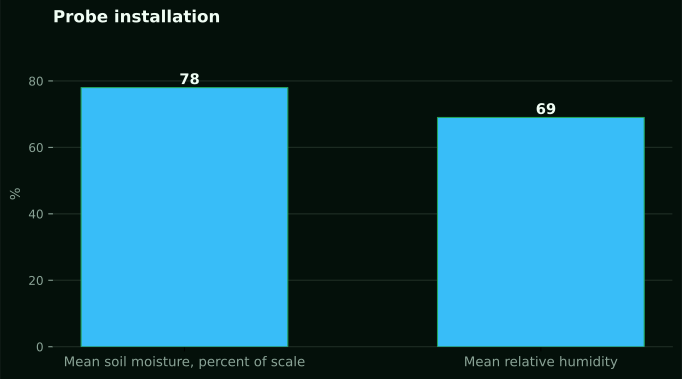
Moisture says the same thing. Across those same 2 probes, the average was 78 % of sensor scale. Most readings fell between 72 and 86 %, pooling both depths. That scale is relative, not calibrated volumetric water content. Don't convert it to m3/m3. The pattern between depths is what matters, not either absolute value.
- Shallow rises, deeper flat: the event wetted the surface only. Do not count it as recharge of the root zone.
- Both rise, shallow first: water is moving down. The delay between the two is the useful piece of information.
- Shallow falls, deeper holds: the topsoil is drying while the reserve below remains. Whether that matters depends on where your roots are.
We've also covered the moisture range each crop wants, read off a probe. That piece explains how to set upper and lower marks for a reading. Use it to decide what counts as wet or dry on your scale. The two depths show you where the water is. The marks show you whether it's enough.
Shallow roots, deep roots, different installations
Put the Iowa rule to work, plain and simple. If a crop's active roots sit within one foot, you need one block. A crop with a deeper root zone needs more. That's the arithmetic of the rule, not a Kenyan crop figure.
With shallow-rooted crops, the shallow reading is your main one. The deeper probe becomes a leak detector. If it rises after irrigation, you may be putting on more than the root zone can hold. For deep-rooted crops, the logic flips. The shallow reading drifts with the weather. It can tempt you to water a crop that's drawing from below.
We don't publish a centimetre figure for either NuaSense depth. Burial depth is chosen per installation, based on crop and rooting pattern. That's deliberate. Fixed depths would work for some crops and mislead on others. If you plant a short-season crop after a deep-rooted one, plan to re-dig.
Where the probe sits relative to the water
Depth is only one coordinate. Iowa guidance says that in a furrow system, shallow blocks go at the furrow edge. Deeper blocks go under its centre. The installation hole goes in the row and angles toward the furrow. Water enters from the furrow. A block under its centre reads very differently from one in the ridge.
That layout comes from Iowa, not a Kenyan scheme. The principle carries over: put the sensor where it samples the water the crop actually uses. With drip, find the wetted edge yourself before you fix a position. We have no Kenyan emitter-spacing figure, so we offer none.
Slope is another factor. On sloping ground, Iowa says put stations at the top, middle and bottom, usually 100-150 feet in from either end. Water runs downhill. A single probe in the middle won't tell you what's happening at either end.
Contact comes last. The Iowa guide says gypsum block accuracy is limited under saline and dry conditions, and the block needs good contact with soil. Soak blocks for at least 24 hours, let them dry, then wet them again right before you install to remove trapped air. No matter the sensor, a probe with an air gap reads that gap.
When the two depths disagree for reasons other than rain
In the North Carolina compaction trial, 59-89% of the total porosity decrease came during the roller's first pass. Pore-size distribution kept changing with extra passes, even after total porosity became stable. This was a controlled roller experiment on a sandy-textured soil in the United States. It tells us nothing about a Kenyan tractor. It does say one pass can do most of the damage.
With a pair of probes, if the deeper reading wets or drains oddly while the shallow one behaves normally, that may point to structure rather than weather. We wouldn't diagnose compaction from readings alone. Let the pattern tell you where to dig, then let the pit show you what's there.
A wrong depth gives a wrong decision
Soil sampling guidance teaches the same lesson. The North Dakota State guidance on soil sampling for fertiliser says pH, phosphorus and potassium are sampled at 0 to 6 inches, the depth tied to crop response, while nitrate-N needs a 0 to 2 foot core. It calls it instructive to split that core into 0 to 6 inch and 6 to 24 inch layers. In no-till, the top 2 inches are separated because surface-applied nitrogen can acidify them enough to reduce crop growth.
That's nutrient sampling, not moisture. We borrow the lesson because it shows different questions need different depths. One number for the whole profile hides what each layer is doing.
The Clemson Land-Grant Press note on depth control shows what getting depth wrong costs. Many labs recommend 6 to 8 inches for tilled areas and only 4 inches for pasture, hay and no-till. In no-till, deeper cores can trigger lime recommendations after the needed lime has been applied, risking high pH in the upper three to four inches. A wrong depth gave a wrong decision, not a blurry one.
Erosion thins the soil you are measuring
The only Kenyan source here is about erosion, not probes. A Cambridge study of cover crops in a Western Kenya maize system found the Calliandra treatment had the lowest runoff (11.6-17.2 mm ha−1) and soil erosion (31-446 kg ha−1 per season) in every season, with Mucuna next. Earthworm abundance was higher under Mucuna and Calliandra (229 and 165 per square metre).
According to the paper, erosion costs you yield in two ways: organic matter and nutrients washed away, plus less moisture available and a shallower rooting depth. In Kenya, the maize yield reductions tied to erosion are estimated at up to 66%. That is where probe depth comes in. Erosion shortens the soil profile you are trying to watch, so a probe buried to where roots reached a decade ago may be sitting in soil that has since thinned. Our post on declining soil health in Kenya goes through the erosion and nutrient drivers behind that loss.
We cannot say cover crops change what a probe reads. The study measured runoff, erosion and earthworms. The moisture link is indirect.
Who should buy two depths, and who should not
Here is where we stand. If you irrigate and the roots push past the top layer, keep two depths. One reading on its own cannot tell recharge apart from depletion. The Iowa guidance backs that up, and it holds no matter who sells the sensor.
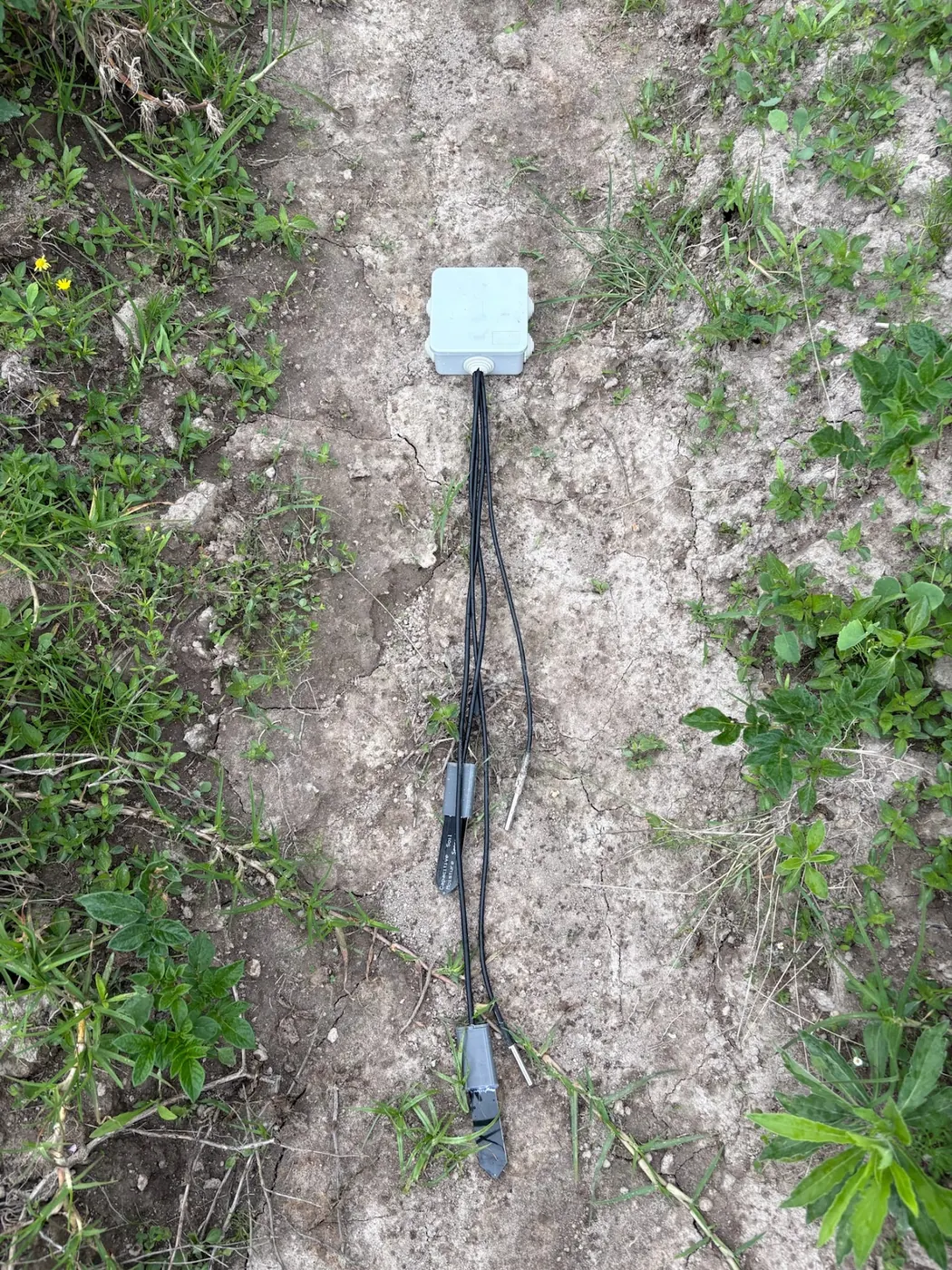
A NuaSense soil sensor reads a shallow probe and a deeper one, each measuring moisture and soil temperature, about every 10 minutes. It talks to the weather station over LoRaWAN, and the station carries the readings to the internet. Price is KES 7,000, or KES 9,000 for the version with two moisture and two temperature channels, taxes not included. The station runs KES 30,000. Readings come as percent of sensor scale, not volumetric water content.
So who should give it a miss? If your plot is small and rain-fed, and you make the call with a spade and a fistful of soil, you do not need a logger. Nor does anyone who will not dig a profile pit first. Put a probe in the wrong spot and you have bought an expensive way to be confidently wrong. And because the sensor reaches the internet through our station, a farm with no station is really buying two things.
If you want a record but cannot decide, start with a hand-held sampling probe and a notebook. They will teach you where the roots actually are. Then make the call. You can read about our soil moisture sensors and soil temperature sensors, or ignore them and use the method alone.