One depth
One sensor where most of the active roots are. It tells you when the crop has started drawing water and it is time to irrigate. Enough for shallow-rooted crops and for a first season.
Soil Sensors Kenya Soil moisture sensor
Read how wet the root zone is about every 10 minutes, at one depth or two, and irrigate when the soil says so instead of by the calendar.
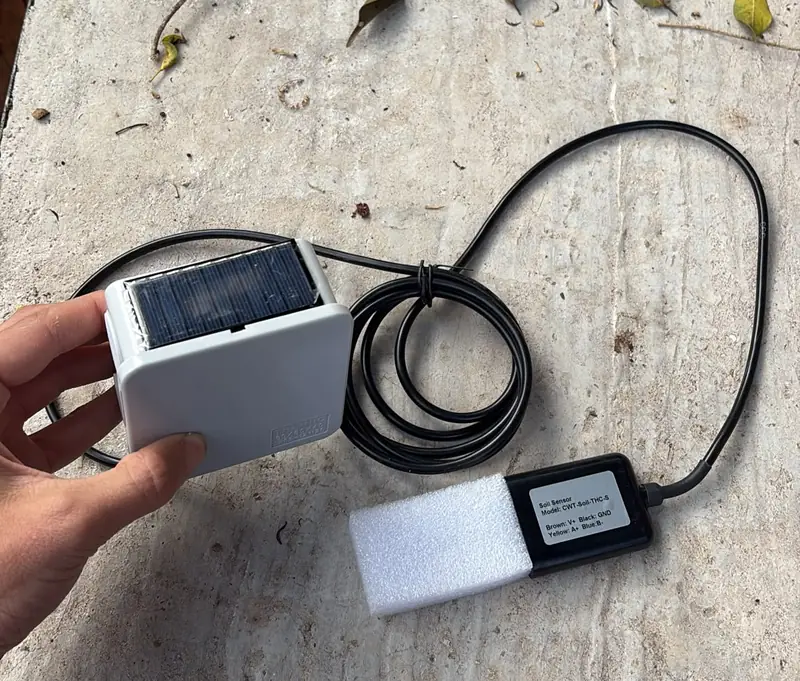
The reading
The sensor reports relative moisture as a percentage of its own scale, not the volume of water in the soil. Readings between 60 and 85 are normal on that scale. It follows wetting and drying faithfully: you see the reading jump after irrigation or rain and fall as the crop draws the water out (percent of scale or volumetric water content).
Each sensor also reads soil temperature at the same depth, and sends both about every 10 minutes. You see them on the NuaSense dashboard next to the rain and air temperature your weather station recorded.
Setting it up
Wet a patch around the installed sensor well beyond what the crop would get in one irrigation.
The reading falls quickly at first. When it stops falling quickly, the number on the dashboard is your field capacity mark.
Irrigate when the reading has dropped a set distance below field capacity, and stop when it comes back. The method in full is in how to calibrate a soil moisture sensor on your own field.
Why the same reading can mean irrigate today on one farm and wait on another: the three numbers you need to read a moisture reading.
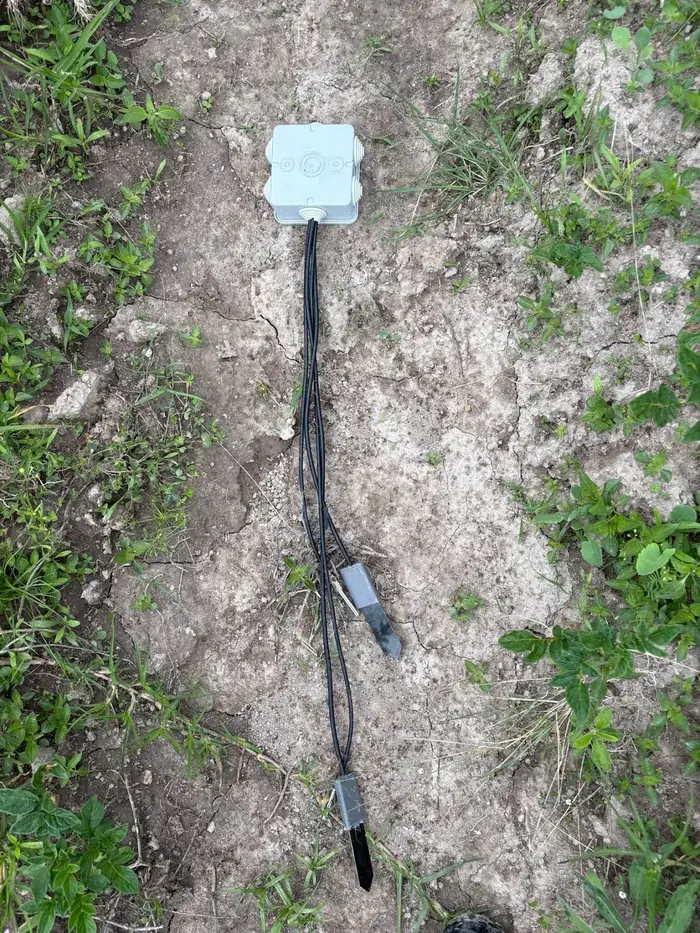
Depth
Each sensor sits on its own cable at the depth you choose, and one node box carries one sensor or several. There is no single correct depth: it follows the crop and how deep its roots go (how deep to bury a soil probe, and why two depths beat one).
One sensor where most of the active roots are. It tells you when the crop has started drawing water and it is time to irrigate. Enough for shallow-rooted crops and for a first season.
A second sensor near the bottom of the root zone shows whether your irrigation or the rain got there, or whether water is running past the roots. This is the version most irrigated blocks want.
Deep-rooted crops and research plots can read more depths from one spot: the node box takes more sensors. Ask us for the price.
In the field
The shallow reading shows the crop drawing the root zone down; the deeper one shows when the water you applied has arrived. Each crop wants its own range: the soil moisture range each crop wants.
Run time depends on how fast your soil takes water in, so measure your soil infiltration rate. The station adds hourly reference evapotranspiration (ET0, FAO-56), which you can turn into an irrigation depth.
After the first showers the shallow reading jumps while the deeper one stays flat until the layer above it is full: how deep the first rains wet the soil.
A sensor that stays at the top of its range after rain is the signal to open the drains: how fast standing water starves roots of air.
Prices
Every soil sensor reads moisture and soil temperature. Choose one depth or two for each spot you want to watch; the sensors come online through a NuaSense weather station.
| What you buy | What it reads | Price, excl. taxes |
|---|---|---|
| Soil sensor, one depth | Soil moisture and soil temperature | KES 7,000 |
| Soil sensor, two depths | Two moisture and two temperature channels, a shallow and a deeper reading | KES 9,000 |
| Soil sensor with EC | Adds electrical conductivity, the salt load of the soil water | KES 10,000 |
| NuaSense weather station Required | Rain, wind, air temperature, humidity, air pressure and sunlight. It also brings the soil sensors online. | KES 30,000 |
Running costs: Safaricom data at cost, typically about one US dollar per station per month (none on Wi-Fi); the dashboard is included with five direct downloads a day; SMS and WhatsApp alerts cost 0.03 US dollars per message. You pay one month after the station is installed and transmitting, with 100 percent money back within the first three months. All prices and terms.
Questions
No. The sensor sends its readings by LoRaWAN radio to the NuaSense weather station, and the station goes online over a Safaricom SIM card, or over Wi-Fi if your farm has it. The Safaricom data fee is passed on at cost, typically about one US dollar per station per month.
That depends on your own soil, so there is no universal number. Find your field capacity mark once by soaking the soil around the sensor and noting the reading when draining slows, then irrigate when the reading has dropped a set distance below that mark.
No. The node box that carries the sensors has its own small solar panel and a battery, and it can also be charged over USB-C. It needs no mains power and no battery changes in the field.
Tell us your crop, how many blocks you farm and how you irrigate. We reply with the number of sensors, the depths we would use and the price.