Measured by NuaSense weather stations and soil probes on Kenyan farms, over the period stated with each figure. Past readings, not a forecast.
Four probes, one phone, and a block that needs watering on Monday
Type "soil moisture sensor" into a phone and four different instruments come back wearing the same name. A tensiometer is a water-filled tube with a ceramic tip and a gauge. A resistive probe is two metal legs, or a gypsum block with electrodes inside. A capacitive probe is a sealed board or rod that senses the soil through its casing. A TDR probe sends a pulse down two rods and times the echo. Different price points, different ways of failing, and two of them give a number the other two cannot give at all.
The backdrop matters. The AICCRA account of tech-backed irrigation in Eastern and Central Africa puts irrigated land in sub-Saharan Africa at less than five percent of cultivated area, against a global average of thirty percent. A probe only earns its keep on the irrigated fraction. If your block is rain-fed, then the question is not which probe to buy. It is whether the reading would change anything you do, and often the honest answer is no.
So this piece is built around one decision: a block in mind, a counter or a listing in front of you. Sandy loam under drip in a greenhouse. A heavier soil under furrow in the open. Or a smallholding where one person waters by hand. The right probe differs in each case, and in one of them the right probe is no probe. No source cited here gives a Kenyan shilling price for any of the four types, so where a price is missing the sentence goes without one. The only Kenyan figures in the piece are the ones NuaSense publishes for its own hardware, and they arrive where the argument reaches them.
Tension or content: the two families answer different questions
The first split is not about price or accuracy. It is about what the instrument physically senses. The Oregon State guide to soil moisture monitoring for irrigation scheduling draws the line: dielectric sensors, which include capacitance and TDR probes, measure water content, while tensiometers measure matric potential. Content is how much water is in the soil. Matric potential, or tension, is how hard a root has to pull to get it.
The same amount of water sits at very different tensions in different soils. A clay holds water tightly. A sand lets it go. A content reading of a given figure means nearly full in one soil and nearly empty in another, which is why content probes need calibration against the soil they sit in. A tension reading skips that step, since the plant does not care how much water is present, only how hard it is to extract. The Oregon guide puts field capacity at approximately -10 to -33 kPa depending on texture, and shows what a content figure buys: a volumetric water content of 0.25 cm3/cm3 through a 12-inch root zone corresponds to 3 inches of stored water. That is arithmetic a content probe allows and a tensiometer does not: depth of water left, set against a known irrigation application.
Resistance blocks straddle the line. The North Carolina State guidance on measuring soil water for irrigation scheduling describes them as two electrodes held in a porous block of gypsum, fibreglass or nylon, with resistance rising as the block's water content falls. The block equilibrates with the soil, so the reading tracks tension more than content, but the number on the meter is in neither kPa nor m3/m3 until someone calibrates it. The colour-coded chameleon sensor in the AICCRA programme belongs here too: it is described as measuring how hard roots have to pull, so it is a tension instrument with a traffic light instead of a dial. Decide which question you are asking first. Depth of water remaining calls for the content family. Stress now or not yet calls for the tension family, and that family is cheaper to interpret.
The tensiometer: your soil texture decides before your budget does
The tensiometer is the oldest instrument on the list. It needs no electronics, and it is the only one with a price in the sources. North Carolina State puts tensiometers at USD 25 to USD 50 each depending on barrel length, with barrels from 6 to 72 inches, and says the only other equipment needed is a small hand-held vacuum pump for calibration and servicing. That is a North Carolina figure for a North Carolina supply chain. Landed in Kenya it will be different, and no source here says what it becomes, so treat it as a sense of scale rather than a quote.
What the price does not tell you is the ceiling. The same guidance explains that a tensiometer breaks tension at approximately 0.8 bar, or 80 centibars, as air enters through the porous tip. Most commercial gauges are scaled 0 to 100 cb, so the dial promises a range the instrument cannot deliver: it works from 0 to 0.8 bar and then stops reading and needs refilling. In a sandy soil nearly all the water a plant can use sits below that ceiling, so the instrument covers the whole working range. In a clay, a large share of plant-available water is held at tensions above 0.8 bar, and the gauge goes blind exactly when the crop is approaching stress.
That is where North Carolina State's recommendation comes from: tensiometers suit sands, loamy sands, sandy loams, and the coarser end of loam and sandy clay loam. On clayey and silty soils they are not recommended, unless you schedule irrigation before 50 percent depletion, as with tomatoes. Treat that as a buying rule. If your block is sand or sandy loam, the tensiometer is the cheapest instrument that gives you a physically meaningful number without calibration. A greenhouse growing tomatoes on a heavier medium can still use one, because the schedule never lets the soil dry far. Heavy clay under a crop you let dry down between irrigations? Wrong purchase at any price. Plenty of irrigated Kenyan land sits on heavy soil. Dig up a handful, feel it, and you will know which side of that line you are on before you spend anything.
Resistive probes and gypsum blocks: cheap legs, exposed metal
The resistive probe is the type most likely to turn up in a parcel from an online marketplace. The PMC assessment of low-cost and higher-end soil moisture sensors describes it plainly: two exposed probes pushed straight into the soil, with electrical resistance tied to water content. The FC-28 they tested carries a product description claiming corrosion-resistant materials for a long service life, but the assessment notes the exact material composition is not specified. Exposed metal carrying current in wet soil will corrode. That is the design, not a defect, and it explains why this type sits at the bottom of the price range.
Accuracy is where the honest surprise sits. In medium-textured soil, with no external converter, the PMC team found the resistive sensor reached a maximum RMSE of 4.79 percent (v/v). That is the error on a volumetric reading. Add a 16-bit ADS1115 analogue-to-digital converter and the same resistive sensor improved to a maximum RMSE of 2.64 percent. The converter is a small board that reads the probe's output more finely than the microcontroller's own input can. It is a board, not a new probe, and it took the error from 4.79 to 2.64.
The gypsum block is the older cousin: a resistive sensor with the electrodes buried in a porous block, so the metal never touches the soil solution directly and the reading equilibrates with tension rather than content. So who should buy resistive? A grower who wants a yes-or-no on a hand-watered smallholding, reads it with a cheap meter, and accepts replacing the legs. Who should not? Anyone whose soil or water is saline, since the Arizona guidance cited below lists salinity among the things that break a factory calibration. And anyone who needs the reading to be the same in six months as it is today.
Capacitive probes: the converter is the upgrade, not the sensor
Capacitive probes read the soil through a sealed casing, so no metal touches the soil solution. That removes the corrosion path. No source cited here states a lifespan in years for any probe type, though, so none appears in this piece. The buying question is whether a cheap capacitive board is good enough, or whether the expensive commercial probe is worth the step up. The PMC assessment answers that, and the answer is not the one vendors give.
Without the ADS1115 converter, the low-cost capacitive sensor reached a maximum RMSE of 3.78 percent in medium-textured soil. With it, 1.87 percent. The higher-end probes in the same trial, the VH400 and the 5TM, reached up to 1.8 percent and up to 0.95 percent respectively. Then comes the finding that should change what you order: with the ADS1115 fitted, the difference between the low-cost and the higher-end sensors was not statistically significant. The accuracy gap was largely a converter problem. A grower building a logger closes most of it with a small board rather than a new probe.
Two cautions before anyone starts treating cheap as the same thing as expensive. That equivalence held only with the converter fitted, and only in medium-textured soil. The Frontiers paper on a low-cost handheld soil moisture sensor tested a cheap device across 408 samples from 83 locations and got a generalised mineral-soil calibration RMSE of 0.035 m3 m-3, bias under 0.001 m3 m-3 and a correlation of R = 0.90. Soil-specific calibration pulled that to 0.031 in loam and 0.034 in sandy loam. In forest organic soil the same sensor slipped to an RMSE of 0.078 m3 m-3 and a moderate correlation of R = 0.80. Against the commercial HydraProbe and ThetaProbe handhelds it agreed at a correlation above R = 0.90.
So how does this transfer to a Kenyan block? Neither trial was run in Kenya, and neither soil set was a Kenyan one. Organic forest soil is not where most irrigated blocks sit, but a greenhouse growing in coir or compost-heavy media is closer to that case than to a mineral loam, and should expect a cheap capacitive probe to be less certain there. On a mineral soil, the cheap probe is a defensible purchase if you add the converter and calibrate against your own field. Calibrate, and you have done what both research teams did. Skip it, and you have bought the factory's soil, not yours. The one argument for the dearer commercial probe that survives these results is a situation the cheap one is known to struggle in: organic media, saline conditions, or a reading someone else will audit.
TDR: the accurate one, with no price in any source
Time-domain reflectometry works by sending an electrical pulse down two rods and timing how long it takes to come back. Travel time gives you water content, and it leans less on soil chemistry than resistive methods do. In the Oregon State classification it sits in the dielectric family alongside capacitance, so it answers the content question. Every source that mentions it calls it accurate and costly. None of them gives a price, so none appears here. Anyone selling you a TDR probe as a budget item is describing a different instrument.
There is a benchmark above all of these, and it costs nothing but labour. The gravimetric method means weighing a sample wet, drying it, and weighing it again. The Frontiers paper calls it the most reliable soil moisture measurement, though it is destructive, heavy on labour and time, and cannot give real-time readings. For daily scheduling that is impractical. For checking a probe it is exactly right. So before you decide whether to spend on TDR, take gravimetric samples next to the cheap probe you already own. If the cheap probe is tracking, the TDR purchase buys convenience, not information.
Scale is where TDR earns its cost on a Kenyan block. Picture a large irrigated block with a long drip main or a pivot, a manager who needs comparable numbers across many hectares, and a budget line for instruments rather than cash handed over at a counter. That is the TDR customer. A smallholding is not, and a greenhouse usually is not. Both are better served by more cheap probes than one expensive one, for reasons set out below.
Side by side: what each probe measures, prices at, and breaks on
The rows below pull together what the sources actually support. Where a row says no source, that is a real gap: nowhere in anything cited here is there a Kenyan price, or a field lifespan in months or years, for any of the four types.
- Tensiometer. Measures tension, how hard roots must pull. Price in the sources: USD 25 to 50 each in the North Carolina guidance, plus a hand vacuum pump. Soils: sands to coarse loam; not clay or silt unless scheduling before 50 percent depletion. Breaks on: air entry above 0.8 bar, needs refilling; no electronics to fail. Fits: sandy blocks, drip greenhouses on light media.
- Resistive probe or gypsum block. Measures resistance, read as content or tension after calibration. Price in the sources: none given; the cheapest electronic type. Accuracy: up to 4.79 percent RMSE in medium soil without converter, 2.64 with ADS1115 (PMC trial). Breaks on: corrosion of exposed legs, salinity, drift. Fits: hand-watered smallholdings wanting a yes or no.
- Capacitive probe. Measures content through a sealed casing. Price in the sources: none given. Accuracy: 3.78 percent RMSE without converter, 1.87 with; not significantly different from higher-end probes once the ADS1115 is fitted; weaker in organic soil (0.078 m3 m-3 in the Frontiers test). Breaks on: cables, batteries, displacement, drift. Fits: mineral-soil blocks, buried logging, two-depth installations.
- TDR probe. Measures content by pulse timing. Price in the sources: none given; described as costly. Accuracy: used as a research benchmark. Breaks on: the same cables and batteries, plus a replacement cost that makes rodent damage expensive. Fits: large irrigated blocks with a manager and an instrument budget.
- Feel and appearance. Measures nothing electronically. Price: zero. Accuracy: within approximately 5 to 10 percent volumetric depending on texture and skill (Oregon State). Breaks on: a tired or new operator. Fits: every block, as the check before any purchase.
Read the soil column first, then the fits column, and only then the price column. A tensiometer is cheap and wrong for a clay. A TDR probe is accurate and wasteful on a smallholding. The cheapest correct instrument is usually the one to buy: on a sandy block the tensiometer; on a mineral loam under drip a capacitive probe with a converter; on a clay under furrow with a crop you dry down, a capacitive or TDR probe and never a tensiometer. Set the feel-and-appearance figure against the PMC numbers and the table makes a second point. A practised hand lands within 5 to 10 percent. A raw cheap resistive probe without a converter reached 4.79 percent RMSE. That hand cannot log, cannot alert and cannot be read from a phone in Nairobi. But it can tell you whether a probe you already own is lying, and whether you need one at all.
How long a probe lasts is a maintenance story
Every grower asks how many seasons a probe survives, and no source cited here answers in months or years. What the literature lists, again and again, is what kills them. The Arizona Extension guide to maintaining and calibrating field-installed sensors names design limitations, battery failures, probe corrosion, mineral buildup, damaged cables, sensor displacement and wireless connectivity problems as what restrains sensor effectiveness in commercial fields. Outright sensor death barely features. Lifespan, in practice, is how long before one of those happens, and whether anyone notices.
Now match that list to a Kenyan block. Cables run through fields where a jembe, a rodent or a tractor tyre will find them. A buried probe with a short cable to a sealed node has fewer places to be cut than one with a long run to a box at the edge. Mineral buildup follows the water: a block irrigating from a borehole with dissolved salts has a mechanism for coating a probe that a rain-fed block does not. Displacement is a trampling problem. A smallholding where everyone walks the rows is harder on a probe than a fenced greenhouse.
Then there is drift, the failure nobody sees. Arizona's guide says sensors drift over time and need frequent recalibration to avoid inconsistent data, and that standard factory calibrations often fail in sandy, clay and calcareous soils, so site-specific calibration for texture, bulk density and salinity is needed. Texture can approximate bulk density: sandy soils about 1.4 to 1.7 g/cm3, loamy 1.2 to 1.5, clay 1.0 to 1.3. That is enough to get a calibration started without a lab.
Not everyone can manage a full lab calibration. Where that is out of reach, the same guide gives you a way to standardise instead. Take the reading when the soil is visibly saturated after irrigation as your near-saturation reference, and the reading taken just before irrigation as the threshold for your own field. Any probe then becomes a scheduling tool, cheap or dear, tied to your ground rather than a factory. The method is set out in how to calibrate a soil moisture sensor on your own field, and it stretches a probe's useful life in a way no purchase can. A probe that has drifted but gets re-standardised every season still tells you the truth about your block. A perfect probe nobody ever checked tells you about its factory. The crop ranges you set those two marks against are in the soil moisture range each crop wants, read off a probe, which also explains why the number on the screen is a scale, not a quantity.
One probe is not a field reading
This next finding should make you reorder the budget. The AGRIS record on linking soil moisture sensors and crop models for irrigation reports that sensors placed close to each other showed important differences in reading. Soil heterogeneity plus sensor faults, it says, make reliable root-zone water status estimates hard to obtain. The work was validated on lettuce grown in greenhouses under reclaimed wastewater irrigation, with a model-based correction that needed only a short calibration period. A greenhouse is about as uniform as agricultural soil gets. The sensors still disagreed.
On an open Kenyan block it is worse. You have a slope, an old anthill, a compacted headland, an emitter that drips harder than the one beside it. However accurate it is, one probe reports one point. Irrigating a block is a decision that needs several points, which favours several cheap probes over one expensive one. Under drip, put the probe inside the wetted bulb. No source here gives a Kenyan emitter spacing, so find the wetted edge yourself: run the system, dig across the line afterwards, and bury the probe in the dark soil.
For the smallholding, all this argues for the colour sensor rather than the numeric logger. The chameleon in the AICCRA programme turns blue when it is too wet, green when moisture is enough and red when it is too dry. That is a design decision, not a downgrade. A worker who cannot read a graph can read a colour. A reading the whole household can act on beats a decimal only the owner understands. By 2024 the programme had distributed over 87,000 sensors to project partners in more than 24 countries. Those are distributions, not sales, and the results it reports come from Uganda and its neighbours, not Kenya.
Smallholding, greenhouse, large block: three different purchases
For a hand-watered smallholding, the right instrument is often a colour-threshold tension sensor, or a single tensiometer on sandy soil, read by whoever does the watering. The AICCRA report from the Mubuku Irrigation Scheme in Kasese District, Uganda, where 70 participants including 24 women were trained in October 2024, quotes one farmer saving 20,000 Ugandan shillings, about USD 5.5, per week and halving his irrigation time. That is a Ugandan scheme on Ugandan soil. The mechanism travels: a person who stops watering when the sensor says stop spends less on pumping. The figure does not travel. The same report notes that soil moisture sensors are typically manufactured in Southern Africa, which makes them difficult and expensive for most farmers in Eastern Africa to access. That is the hidden line in every quote, and an argument for a seller who can replace a corroded leg without another import. If the probe carries a radio, ask whether the Communications Authority of Kenya has type-approved it. A seller who cannot answer has already told you something about after-sales support.
In a greenhouse on drip, the medium decides. Light sandy media, or a tomato schedule that never passes 50 percent depletion, suits a tensiometer. Coir or compost-heavy media push you toward a capacitive probe with a converter and a site calibration, because the Frontiers organic-soil result says the factory curve will not hold. Several probes, not one.
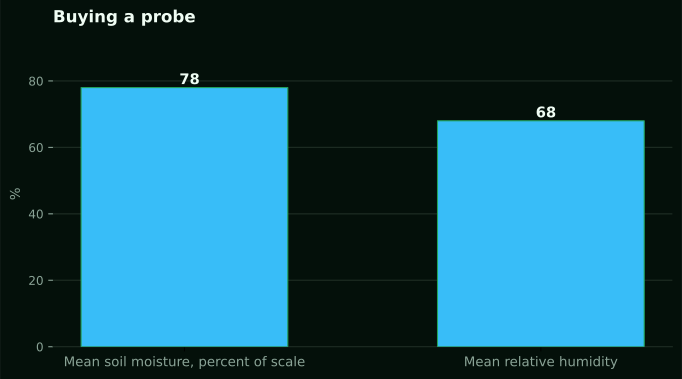
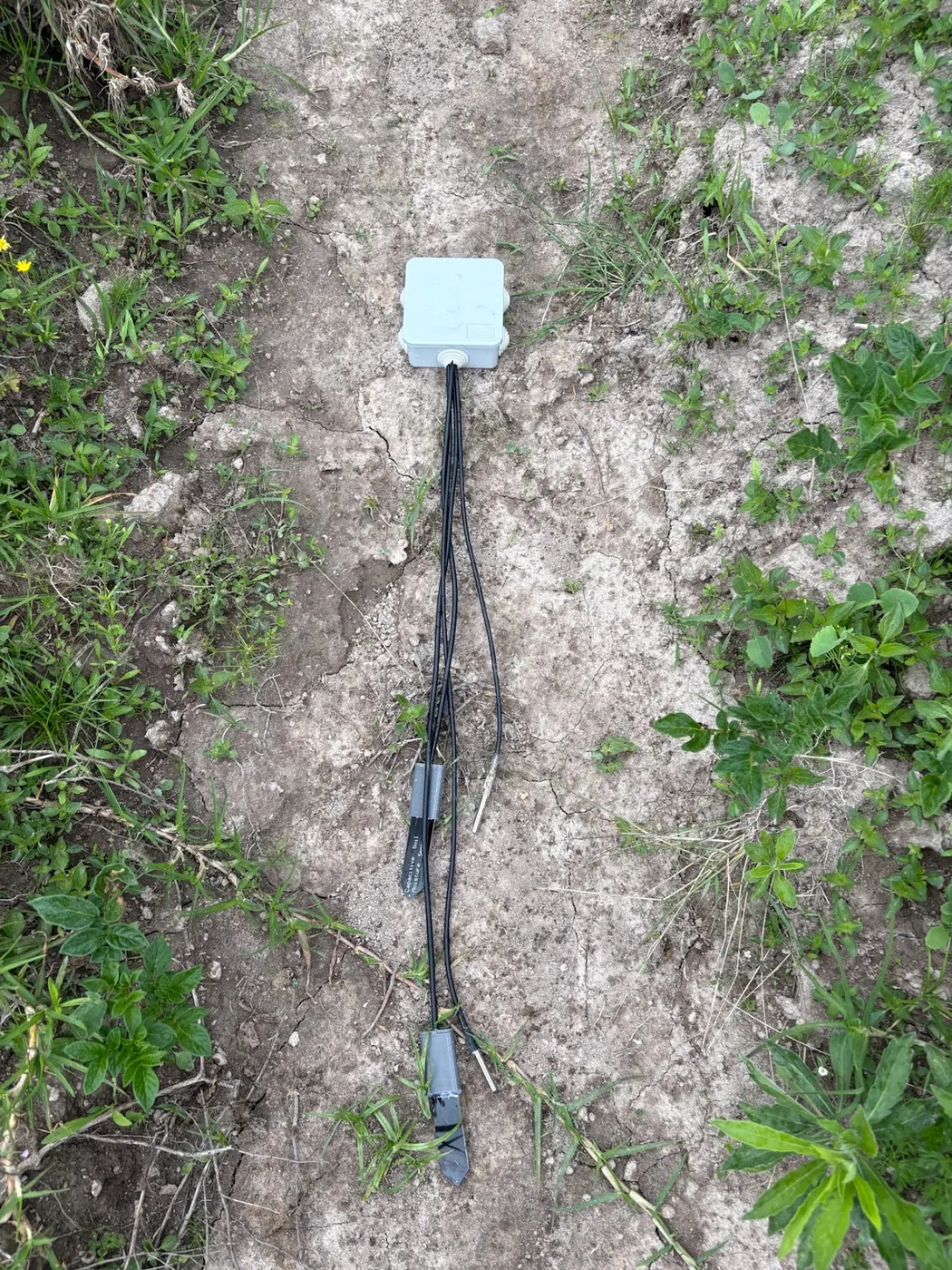
On the large irrigated block, logged probes at two depths reporting to a dashboard earn their price, and that is where NuaSense sits. A NuaSense soil sensor costs KES 7,000 excluding taxes, a two-moisture two-temperature variant KES 9,000, and a version that also measures EC KES 10,000. It reports roughly every 10 minutes over LoRaWAN to a NuaSense weather station at KES 30,000, which carries the readings to the internet. The reading is percent of sensor scale, not calibrated volumetric content. Across 7 of our probes over 18 September to 18 October 2026 it averaged 78 percent of scale, with most readings between 72 and 86, and that scale means something only once you standardise it against your own saturation and pre-irrigation marks. Who should not buy one: a rain-fed block, a grower who will not do the standardisation, and a smallholding where a colour sensor and a person answer the question. In those cases the first shilling belongs in the water system itself, and the NuaSense overview of smart irrigation in Kenya covers drip kits, gravity-fed systems and solar pumping for exactly that block. What we ship, and at which depths it is installed, is on the soil moisture sensors page.