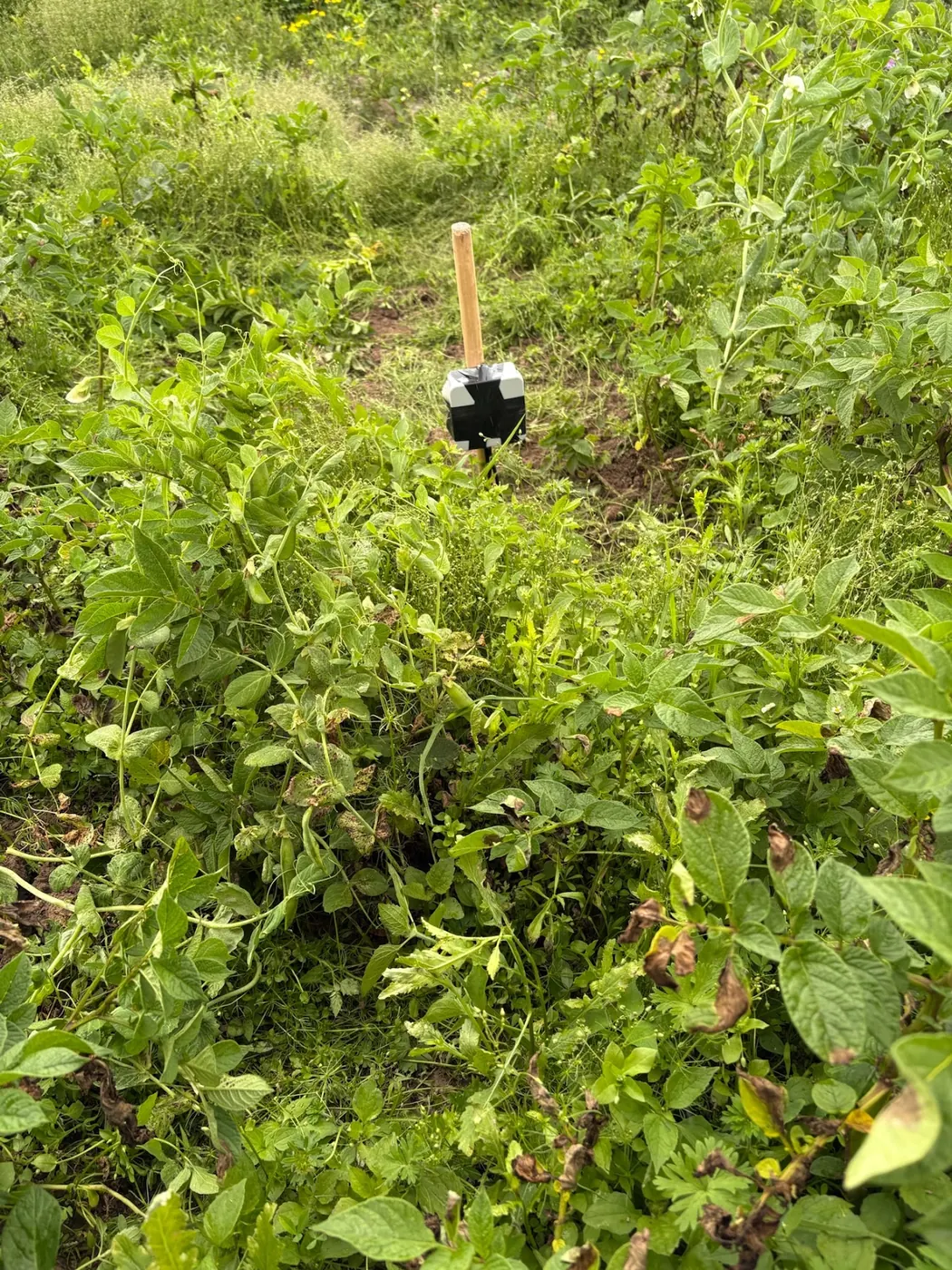
Two numbers from one bed, a hand's width apart
A greenhouse manager in Kenya has a probe left in the bed since transplanting and a handheld soil moisture meter in a jacket pocket. The agrovet counter said the handheld was a check on the buried probe: push it in next to the cable, compare the two, and whichever number is further from what the plants look like is the one lying. That advice fails on the first morning it is tried. Pushed in beside the cable, the handheld reads drier. On the phone, the probe trace has been climbing since the drip ran before dawn. Nothing has been disturbed. Two numbers and no rule for choosing between them is a worse position than one number.
Trace that advice back and it rests on four assumptions. Both instruments sit on the same scale. Both read the same soil. Both read it at the same moment. Both read it in the same place. None of those holds by default, and each fails in a way a grower can see without a laboratory. A handheld samples the soil around its tines at the instant it goes in, and the tines break that soil as they enter. A buried probe samples soil that settled around it weeks ago, at a depth chosen at installation. It reports every few minutes whether anyone is looking or not. One is a photograph. The other is a film. Asking which is right is the wrong question; the right one is which question you were asking. This piece takes the four assumptions in turn, and in most cases the fix costs nothing.
Same scale? Usually not
A handheld's number may be a volumetric water content, a percentage of the sensor's own range, or a tension. A buried probe's number may be any of those as well, and the box does not always say which. One clean example sits in the Oregon State guide to soil moisture monitoring for irrigation scheduling: a volumetric water content of 0.25 cm3/cm3 in a 12-inch root zone is 3 inches of stored water, and field capacity sits at roughly -10 to -33 kPa depending on texture. A volume fraction, a depth of water and a suction are three descriptions of one wet bed. Two instruments quoting two of them will never agree in digits.
NuaSense probes report relative moisture as percent of sensor scale, and readings of 60 to 85 on that scale are normal. That is a position on the probe's own range, not a volumetric figure, so a handheld printing volumetric percent is on a different axis entirely. Part of the greenhouse disagreement is just this. Turning any raw reading into a decision takes three numbers: the saturated reading, the field capacity reading and the one you refuse to go below. For a buried probe, the earlier post on the three numbers behind a soil moisture reading works those out. A handheld needs its own three, found separately in the same bed. Until then, comparing raw digits is comparing Fahrenheit against Celsius and declaring one thermometer broken.
A factory curve built on somebody else's soil
Low-cost handhelds arrive with a curve built on soils their maker could reach. The Frontiers study developing a low-cost handheld soil moisture sensor calibrated its instrument on 408 soil samples from 83 locations, 301 of them from 70 mineral soil sites and 107 from 13 organic soil sites. On mineral soils one general calibration gave an RMSE of 0.035 m3 m-3, a bias below 0.001 m3 m-3 and a correlation R of 0.90. Soil-specific calibration tightened that only slightly, to 0.031 m3 m-3 for loam and 0.034 m3 m-3 for sandy loam. On forest organic soil the same handheld degraded to an RMSE of 0.078 m3 m-3 with R = 0.80, roughly double the mineral error. Once calibrated it agreed with the commercial HydraProbe and ThetaProbe handhelds at R above 0.90.
Read that as a Kenyan grower and two things follow. First, a general mineral-soil calibration is not a disaster: the soil-specific curves bought very little over it, so a handheld used across several mineral-soil blocks in one county does not need a fresh curve for each. Second, the organic case is the trap. Those calibration sites were forest soils, not Kenyan ones, and no Kenyan table for this handheld exists. But a raised bed heavy with compost, a coir bag, or a dark valley-bottom patch sits closer to the organic end than the loam end. The honest expectation there is the doubled error. A handheld bought for the open field and walked into the compost beds has changed instruments without changing hands. Before any price, the agrovet conversation starts with what is under the tines and whether the maker's calibration soils resemble it.
Push it in three times, not once
That same Frontiers team did not trust a single insertion, and neither should a grower. At each location their protocol took three handheld readings in a triangle. It pulled the gravimetric core from the centre and used the average of the three as the representative value. Any grower can copy it with no purchase: three insertions around the point you care about, the mean written down, the outlier ignored. One push lands in a root, a stone, a dry crumb or an air pocket as often as it lands in representative soil. Three pushes average most of that away.
Where the triangle goes is the Kenyan part. Uneven wetting from drip and micro-sprinkler is named in the Arizona Extension guide to maintaining and calibrating field-installed soil moisture sensors as a main reason readings are hard to interpret. It recommends multiple sensors at several depths and positions for exactly that reason. On a Kenyan drip block, often hand-laid line with emitters spaced by the installer rather than a catalogue, the wetted bulb is a narrow strip and the soil between lines can be dry while the strip is saturated. A triangle with one corner on the line and two in the dry inter-row returns a meaningless mean. Put all three corners at the same distance from the emitter. Decide beforehand if the question is the bulb or the gap, and record which. A buried probe was placed once, in a known position relative to the emitter, and has stayed there. Its number is always about the same soil. A handheld's number is about wherever the tines went that morning.
Dawn and midday are two readings
Temperature makes capacitance electronics drift. The Nature study on IoT soil moisture measurement and soil type prediction puts the cost at about ±0.5% accuracy per degree Celsius in uncontrolled field conditions; that is why temperature compensation algorithms were introduced at all. The figure applies to the sensors in that study, not to any particular handheld or to NuaSense hardware. The mechanism, though, is general: the circuit that turns capacitance into a number warms and cools too.
Our own network gives a sense of the swing a Kenyan probe lives through. Across 10 NuaSense soil probes from 25 September to 25 October 2026, with each reading at a shallow and a deeper position, the steadier depth moved through 1.9 °C over the period. The more variable one moved through 6.5 °C. We publish no accuracy figure for our own hardware, and this piece will not derive one from those swings. The point is the mechanism: a capacitance circuit warms and cools with the soil around it, and the deeper depth crosses a much smaller range than the shallow one. Air temperature across 13 stations in the same month ran from 0.0 to 36.7 °C. A handheld carried in a hot pocket and pushed into a cool bed crosses a far larger range than either buried depth. No number is needed for the rule: take spot readings at the same time of day each time, early if you can, and compare a handheld against the buried probe only at that hour. A midday handheld against a dawn probe trace is a disagreement the grower manufactured. On a buried probe, the deeper, steadier channel is the one least troubled by this, which is one more reason to treat it as the reference and the handheld as the visitor.
Salt and clay move the number before the water does
What undermines capacitance accuracy, according to the Nature review's list, is salinity, soil texture, environmental diversity, sensor-to-sensor variability, and a fall in sensitivity at high water content. Salinity is the quiet one. Dissolved salt raises conductivity, and the sensor cannot tell that from water, so a salty bed reads wetter than it is. That review used logistic regression specifically to blunt the effect of electrical conductivity. A Random Forest classifier identified soil type from sensor data with roughly 97.77% accuracy, which the authors read as soil type having to be settled before a capacitance number can be interpreted at all. Texture first, then salt, then moisture.
For a Kenyan grower on borehole water, the salt question is live and the handheld cannot answer it. On texture, the One Acre Fund introduction to East African smallholder agriculture notes that clay soils hold moisture and nutrients very well and sometimes too well, being more prone to waterlogging. A healthy-looking handheld reading in a clay bed may describe a root zone already short of air. The PMC sensor comparison notes that denitrification becomes more important above 60% water-filled pore space because oxygen supply falls, so an over-wet reading is not harmless. A buried probe sees the slow climb toward that state across days. A spot check sees one point and cannot know whether the bed is on its way up or down.
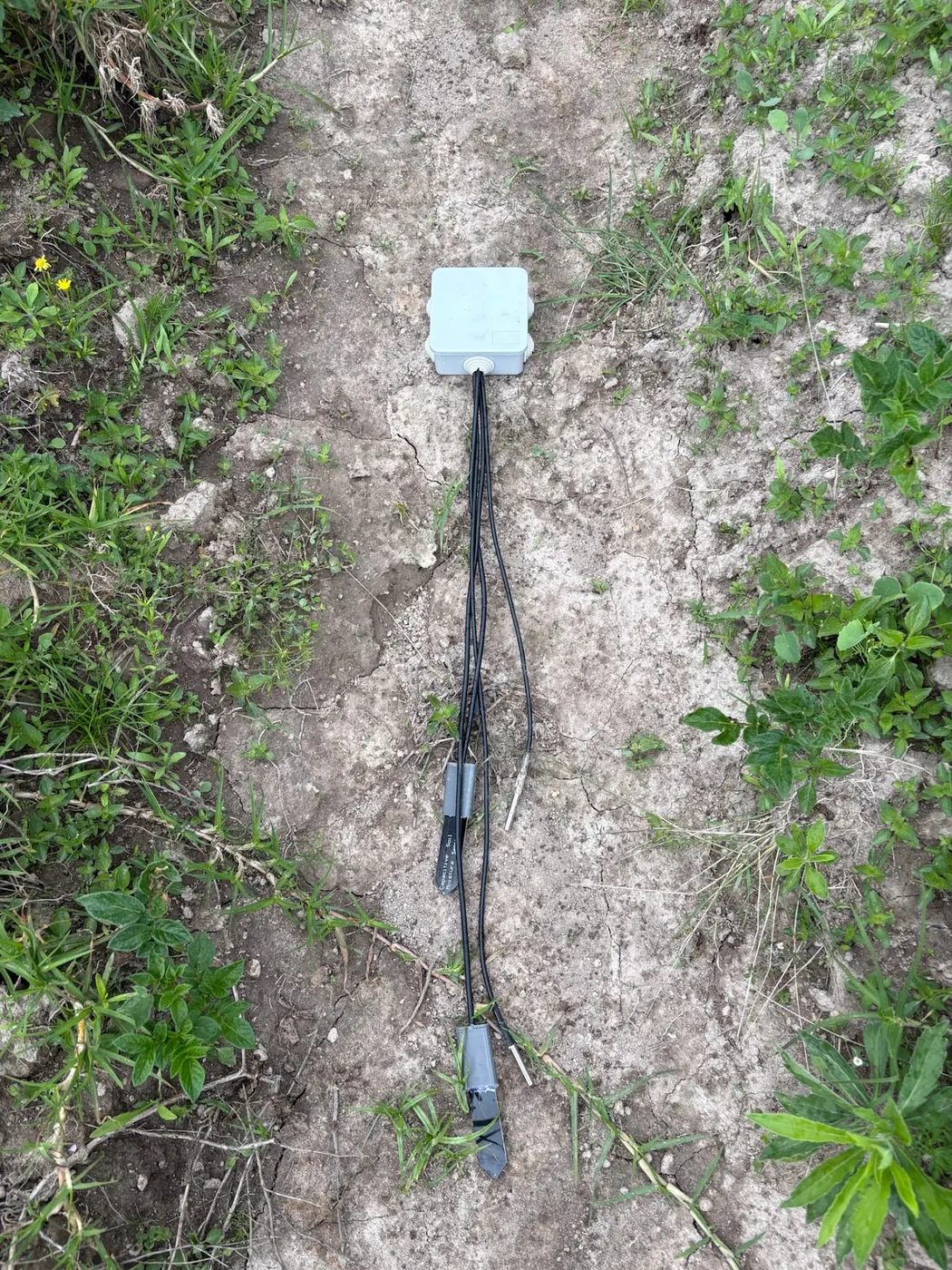
A colour that says stop is a different product
Not every grower needs a number. The AICCRA account of tech-backed irrigation in Eastern and Central Africa describes the chameleon sensor used in the Virtual Irrigation Academy: blue if the soil is too wet, green if there is enough moisture, red if it is too dry. In the programme's second phase the sensors are described as measuring how hard roots must pull water from the soil, which is tension rather than content. No percentage to interpret, no field capacity to look up, no scale to convert. Alongside it the toolkit carries a FullStop wetting front detector that shows when water has moved deep enough to stop irrigating, nitrate strips and an EC meter, that last one being the salt answer the handheld lacks.
Regional numbers in the same account explain why this matters here. Less than five percent of cultivated land in sub-Saharan Africa is irrigated, against a global average of thirty percent. Soil moisture sensors are typically manufactured in Southern Africa, which makes them difficult and expensive for most farmers in Eastern Africa to reach. By 2024 more than 87,000 sensors had gone to partners across more than 24 countries. In October 2024 ASARECA, AICCRA, MAAIF, NARO and Malawi's Kasinthula station trained 70 participants, 24 of them women, at the Mubuku scheme in Kasese, Uganda. One farmer there saved 20,000 Ugandan shillings a week and halved his irrigation time. Those are Ugandan scheme results and say nothing about Kenyan yields; what transfers is the design lesson. A colour threshold and a numeric handheld are not rivals for the same buyer. Colour removes the interpretation step and with it most of the ways a spot reading goes wrong. Numbers keep the step, and with it the duty to know your texture, your salt and your three numbers. A grower who will not do that work is better served by the colour.
Why the fixed spot matters more than the electronics
Oddly, the strongest argument for a probe left in place comes from a study that used a handheld. In the FAO-hosted trial of soil moisture under Eucalyptus plantations, an electronic soil moisture meter was read at four depths (0-60, 61-90, 91-120 and 121-150 cm) in holes of roughly 5.0 cm diameter bored with a manual auger, monthly on a fixed date for two years, at Mathura and Billhaur in India. Moisture peaked in the rainy months and was lowest from April to June at both sites. Under plantation it was generally higher than in the unplanted control at all four depths, with the two deepest staying higher year-round, which the authors read as the plantation not depleting subsoil water. Billhaur held more moisture than Mathura in every one of the twelve months, and the authors put that down to edaphic factors, especially texture.
The last line is the one to carry home. Two sites, same instrument, same schedule, and they differed every single month because of what the soil was, not what the weather did. A grower roaming a Kenyan block with a handheld compares sites in exactly that way, and a lower reading at the far end may be a texture difference that has been there since the land was cleared. Only a reading taken in the same spot again and again separates the soil from the water. That trial got round it by boring holes in fixed positions on a fixed date, which is a buried probe in all but the cable. Similar logic appears in the Qilian Mountains study estimating regional soil moisture from NDVI: satellites could see moisture only to about 5 cm, so probes were installed at 0-10 down to 50-70 cm to get the profile, with correlations between 0.47 and 0.94 across 31 zones. Surface spot data needs a fixed deep reference. Which depth that is belongs to the crop, and the crop side of the question, variety by altitude band and planting, is covered in the NuaSense guide to growing maize in Kenya, ground this site leaves alone.
Calibrating either one with an oven and a kitchen scale
Both instruments can be tied to the truth without a lab. Arizona's field calibration takes soil at the same depths as the installed sensors. It weighs the sample fresh, dries it at 105 degrees Celsius in an oven until the weight stops changing, subtracts the tray, then uses bulk density to convert it to volumetric content. Bulk density is the sticking point, and farms rarely know it. The guide gives approximate values by texture: about 1.4-1.7 g/cm3 for sandy soils, 1.2-1.5 for loamy, and 1.0-1.3 for fine-textured or clay soils. Those are not Kenyan measurements. Treat them as a bracket, not a fact, and write that down in the notebook.
The same guide has a cheaper route that skips the oven. Read the sensor before, during and after an irrigation. Take the visibly saturated reading as the near-saturation reference, and set thresholds from the readings taken just before each irrigation. A buried probe handles that by itself. A handheld only works if the triangle goes into the same marked spot every time. For the handheld, the PMC assessment of low-cost and higher-end soil moisture sensors found electronics mattered as much as the sensor. On Arduino's built-in converter, maximum RMSE in medium-textured soil was 4.79% for resistive units and 3.78% for capacitive units. A 16-bit ADS1115 converter cut those to 2.64% and 1.87%, leaving no statistically significant gap to the VH400 at up to 1.8% and the 5TM at up to 0.95%. Without that converter, the gap was real. The box rarely says which chip sits behind the screen.
What a buried probe costs, and who should keep their money
A NuaSense soil sensor sells for KES 7,000 before taxes. The two-moisture, two-temperature version costs KES 9,000, and the one that also measures EC costs KES 10,000. It reads at a shallow and a deeper position, with moisture and soil temperature at each. Roughly every 10 minutes it sends a reading over LoRaWAN to a NuaSense weather station. That station costs KES 30,000 and carries readings to the internet on a Safaricom SIM for about one US dollar a month, or on Wi-Fi for nothing. Moisture comes back as percent of sensor scale. Across 10 probes from 25 September to 25 October 2026, the pooled average was 73 percent of scale, with most readings between 43 and 86. Soil texture on the dashboard comes from iSDA and SoilGrids map values of around 2016 vintage. It is a starting bracket for the bulk density question above, not a soil test of the field. More is on the soil moisture sensor page and the soil temperature page.
It is just as clear who should not buy one. A rain-fed block with no irrigation decision gives a probe nothing to decide. There, the feel method is enough. Oregon puts it within about 5% to 10%, depending on texture and operator skill. A borrowed handheld at a fixed hour is enough too. A grower with a few greenhouse beds who walks them every morning gets most of the value from a colour tool and a marked spot for three handheld pushes. Field-installed sensors fail in the ways the Arizona guide lists: battery, corrosion, mineral build-up, damaged cable, displacement, lost signal. They also drift. A probe nobody will recalibrate is a line on a phone, not a measurement. A buried probe earns its price when direction matters: a drip block climbing toward waterlogging over a week, a deeper channel that has stopped responding, a bed drying faster now than at transplanting. Those ask how the soil got here. A spot check answers what the soil is now. On a Monday morning with the pump ready, that is often the only question being asked. Trust the instrument built for the question. When the two disagree, one of the four assumptions has broken. You can usually see the break by looking at where the tines went in.