Two electrodes, a field, and the soil in between
A capacitive soil moisture sensor begins with two metal pieces. They never touch soil water. On cheap board probes sold in Kenyan agrovets, those pieces are copper tracks under a resin coat, so no current leaks into the ground. On buried commercial probes, they are rings or plates inside a plastic body. Between them is whatever you push the probe into: mineral grains, air in the pores, water filming the grains, and dissolved salt in that water. An Institute of Hydrology report on its capacitance probe describes an instrument built on exactly this arrangement. There the soil forms part of the electrical circuit; it is not tested by a current passed through it.
Apply a voltage across the two conductors. An electric field forms between them and spreads a short way into the soil. It does not travel far. The field lives in a small envelope around the electrodes. Everything the probe will ever tell you comes from that envelope: a handful of soil, not the bed, not the block. Electrodes plus the material between them make a capacitor, which stores electric charge. Its capacitance is how much charge it holds at a given voltage. Capacitance depends on what fills the gap. Water changes that filling more than anything else in the ground. But nothing in the probe recognises water as water. It only notices the field has become easier to set up, and the circuit downstream has to guess why.
Water bends the field more than anything else in the ground
Permittivity, also called the dielectric constant, decides how much charge the gap can hold. High permittivity means more charge stored; low permittivity means less. Liquid water has a far higher permittivity than dry mineral grains or air. That is the useful accident the whole instrument rests on. A water molecule is lopsided, with its charge pulled to one end. When a field is applied, the molecules swing round to line up with it. That alignment soaks up charge. Quartz grains, clay plates and air do nothing of the kind.
As a bed wets up, the envelope around the electrodes fills with material that stores charge readily, and capacitance climbs. As it dries, capacitance falls back. The Egyptian low-cost capacitive sensor paper contains a review of the rival methods. It explains why the authors chose a dielectric technique: accuracy, simple installation and a wide measuring range for soil water content. Soil resistivity, the method behind two-prong probes with bare metal, is simple and low cost. But it needs careful calibration and installation, and salinity affects it. Tensiometers are easy to use but have a low range. Neutron scattering carries a radiation health risk. Weighing a soil sample wet and then dry, the thermo-gravimetric method, remains the reference. It is laborious, destructive and slow.
Dielectric wins because water's permittivity sits so far above everything else that it dominates the signal. That dominance is also the trap. Anything that changes how the soil stores charge, water or not, moves the reading. Salt and temperature both do.
The circuit turns capacitance into a voltage, and the voltage falls as the soil wets
Capacitance on its own cannot be sent over a radio. Boards convert it. Usually the probe's capacitor becomes part of an oscillator, a circuit that swings a signal back and forth at a frequency set by the capacitance: more capacitance, slower swing. A second stage turns that frequency into a steady voltage. The microcontroller reads that voltage. Its direction surprises people. In lab and greenhouse tests of the Egyptian build on clay textured soils, output voltage fell as soil moisture rose. The average coefficient of determination was 0.967 against volumetric water content, and the root-mean-square error was 0.014 on that scale. Plainly: on that clay, in that lab, the voltage tracked water content closely enough that one curve explained nearly all the variation.
Read the result for what it is. It was measured on clay, indoors, with a curve fitted by the people who built the board. It says the physics works and the circuit is stable. It does not say that a board bought in Thika and pushed into a red loam will carry 0.014 of error, because nobody has fitted that curve for that soil. What transfers to a Kenyan block is the shape: voltage goes down as water goes up, and the relationship is close to a smooth line once someone has drawn it. What does not transfer is the error figure. That figure belongs to the soil and the samples it was measured against. Every capacitive probe on the market, including the ones on our soil moisture sensor page, is some version of this chain: electrodes, oscillator, voltage, number. Same chain. Different curve.
Why the phone shows percent of scale
That voltage has a lowest value and a highest value. The lowest is roughly what the board reads in air or bone-dry sand. The highest is what it reads with the electrodes in water. Most firmware takes those two points, calls one 0 and the other 100, and reports where today's voltage sits between them. That is percent of scale: a position on the probe's own range, not a water content. Our LoRaWAN probes report exactly this. Over 18 September to 18 October 2026, 7 probes on our network averaged 78 percent of sensor scale, with most readings between 72 and 86 percent. Those are ordinary numbers on that scale. As volumetric water content they would be absurd, since no soil holds 78 litres of water in 100 litres of ground. An earlier piece on percent of scale against volumetric water content works through why the two get confused. So here only the one point the physics forces.
The market is confusing by design. Arizona's guidance on soil moisture sensor selection says a sensor that reports volumetric moisture, or a percentage, should carry a range of 0 to 100 percent volumetric moisture content. That is a datasheet convention. Now put it next to the Nigerian automatic fertigation system described on AGRIS, which held cucumber moisture between 25 and 46 percent with a capacitive probe. The record never says which scale that band sits on. A grower could treat 25 to 46 as a target and apply it to a dashboard showing percent of scale, where 46 would mean a very dry bed. Establish the scale before you act on any percentage from any probe. What reaches the phone is a voltage stretched to fit between two reference points, nothing more.
The calibration curve, and the error it carries
To turn percent of scale into water content, pair probe readings with soil samples weighed wet, dried and weighed again, then fit a line through the pairs. That job is bigger than people think. A Frontiers paper on a low-cost handheld soil moisture sensor drew 408 soil samples from 83 locations to build its curves: 70 mineral soil sites gave 301 samples and 13 organic sites gave 107. When all mineral sites were pooled into one generalised calibration, the sensor managed an RMSE of 0.035 m3 m-3, a bias under 0.001 m3 m-3 and a correlation of R = 0.90. Fitting a separate curve per soil cut the error a little: 0.031 for loam, 0.034 for sandy loam.
Translate that into grower units. A cubic metre of soil is 1,000 litres, so 0.035 m3 m-3 means 35 litres of water per 1,000 litres of soil, or 3.5 litres in every 100. That is the usual miss, either way, after the full calibration job. Now compare the Egyptian 0.014 on a single clay in a lab: one class of instrument carries very different uncertainty depending on whose curve you use and how many soils it must cover. Commercial handhelds, HydraProbe, ThetaProbe and TDR 100, sit at RMSE below plus or minus 0.04 m3 m-3 in the same paper, and soil-specific calibration is still recommended even for those. The cheap sensor agreed with those meters at R above 0.90. So once both are calibrated to the soil, the gap between a cheap capacitive probe and an expensive one is smaller than the gap between calibrated and uncalibrated. Calibration is the purchase; the board is the deposit.
No Kenyan version of that 408-sample table exists. Nobody has taken a handheld through 83 Kenyan sites and published the curves, so a grower waiting for that will wait a long time. Our field capacity calibration post lays out the small version instead: a few samples from your own bed, taken at known readings, dried and plotted. Until you do that, treat every converted figure as carrying at least the generalised 0.035 error, probably more. Remember too that the decision you act on, irrigate or wait, usually needs only the direction of the trace, never the third decimal.
Two identical probes do not read identically
Here is the number that changes the economics. The Egyptian team tested several units of their own design in the same soil, and the sensor-to-sensor variability test gave a coefficient of variation of 0.045. Two boards from one batch, with the same circuit and the same resin, do not produce the same voltage in the same wet soil. There are slight differences in copper tracks, coating thickness, component tolerance and how straight each one was pushed in. None of that is a defect. It is what mass-produced electronics look like before anyone matches them.
On a block, that means a calibration curve belongs to a probe, not to a model. Suppose the shallow probe in bed four dies and a replacement goes into the same hole. The new unit sits at a different point on its own scale for the same water. Last season's curve is now wrong by an unknown amount, and the alert threshold on the dashboard points at a different wetness than before. A cheap single-probe purchase becomes a recurring calibration task, one per replacement. There are two ways to live with it. Stop converting and use percent of scale as a relative trace. Learn what the number looks like after irrigation, after rain, and when the crop starts to wilt, then relearn it when a probe is swapped. Or redo the samples at every change. For most Kenyan irrigation decisions the first is enough. A reading that has slid from the mid-80s to the low 70s on our scale over a dry week says the soil is drying and roughly how fast, whichever probe sent it.
Salt in the pore water pulls the reading
So far, soil has been treated as water, air and grains. Dissolved salt is the fourth ingredient, and it comes in by a side door. Salty water conducts. A conducting material between the electrodes acts partly like a resistor and partly like a capacitor, and the oscillator cannot cleanly tell the two apart. A CGIAR assessment of temperature and salinity effects on dielectric sensors states the consequence directly: dielectric sensors measure both soil moisture and salinity, with moisture coming from the dielectric reading. One sensor, two things at once. On a block fed from a borehole that is slowly salting the bed, the probe can report wetter soil than the plant is feeling. Salt is helping the field store charge, and the circuit reads that help as water.
No source gives a correction factor, and this piece will not invent one. What the sources give is practice. Arizona's guide says capacitance sensors should be calibrated for the specific soil type, sandy, loamy or clayey, and that saline ground needs units designed for saline environments plus regular calibration. AICCRA's account of the colour-threshold programme pairs its moisture sensors with a soil conductivity meter, nitrate strips and a wetting front detector rather than trusting one number. That pairing is the answer in Kenya too. Read EC beside moisture, and when EC is climbing, distrust the moisture reading in that bed. We sell a probe variant that also measures EC at KES 10,000 excluding taxes, against KES 7,000 for the basic sensor. But EC is not currently streaming from the deployed fleet, so a grower who needs it today should ask rather than assume it arrives on the dashboard. If your borehole water has never been tested, that question comes before any probe.
Temperature moves both the water and the circuit
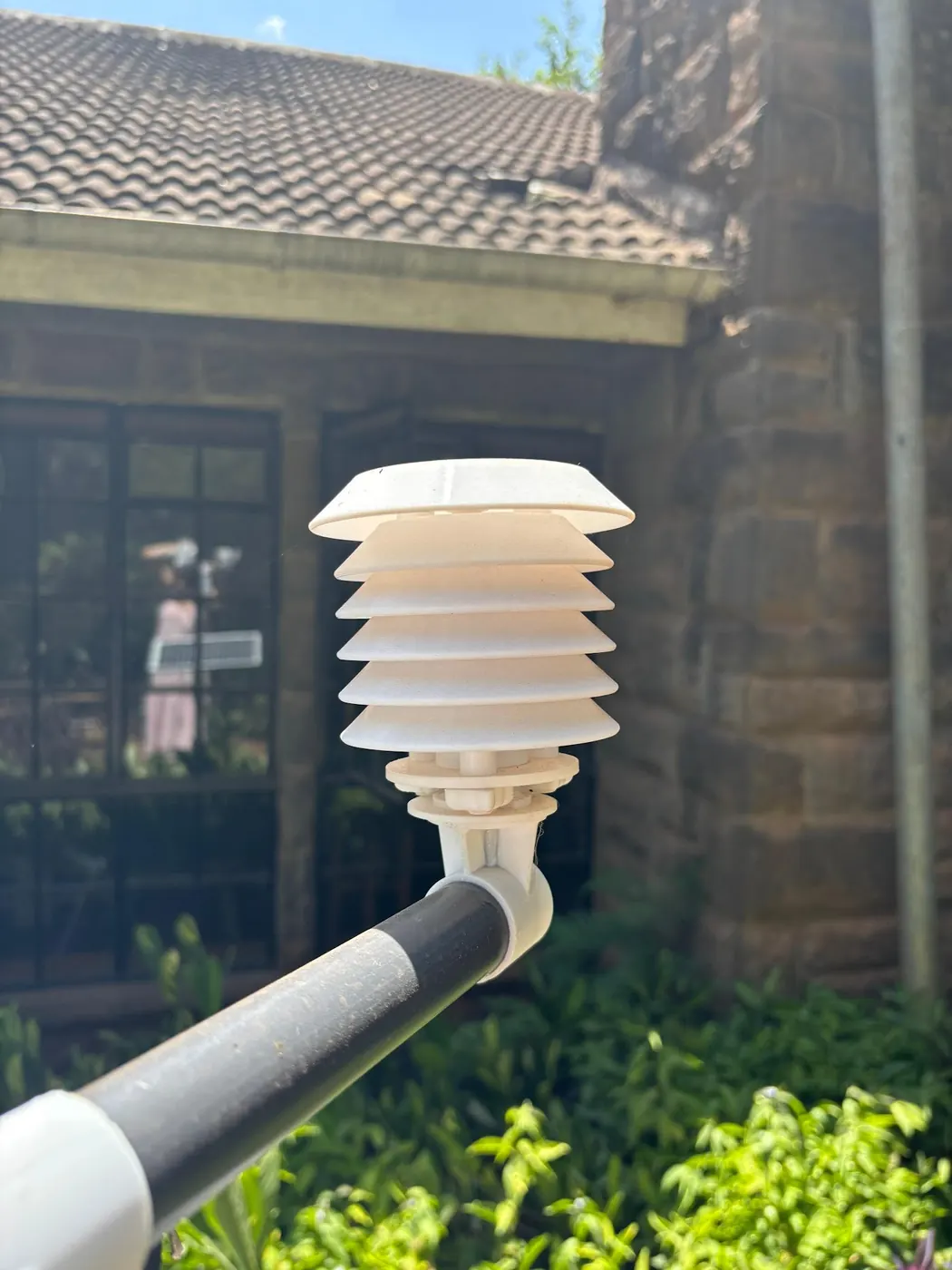
Temperature gets into the reading by two routes. No source in this bank puts a number on either one, so this section carries none. Route one is the water. Water's permittivity changes with temperature: warmer molecules are more agitated and line up with the field a little less readily. So the same litres give a slightly different capacitance at dawn and mid-afternoon. Route two is the electronics. The capacitors and resistors that set the oscillator's frequency behave differently with temperature, and a board in full sun is warmer than the same board at night.
On a block, the shallow probe is where this matters. Each of our sensors has a soil temperature channel at both of its depths. From 18 September to 18 October 2026, across 7 probes, the steadier depth moved through 1.4 °C and the more variable one moved through 3.8 °C, a factor of 2.7. So if the shallow moisture trace wobbles over a rainless, unirrigated day and the deeper one stays flat, suspect heat on the sensor first, not water moving. That is why both channels sit on one unit, and why the soil temperature sensor page treats temperature as moisture's companion. When you make a decision, compare readings taken at the same hour. Dawn against dawn removes most of the swing without a correction you do not have.
A litre of soil decides everything
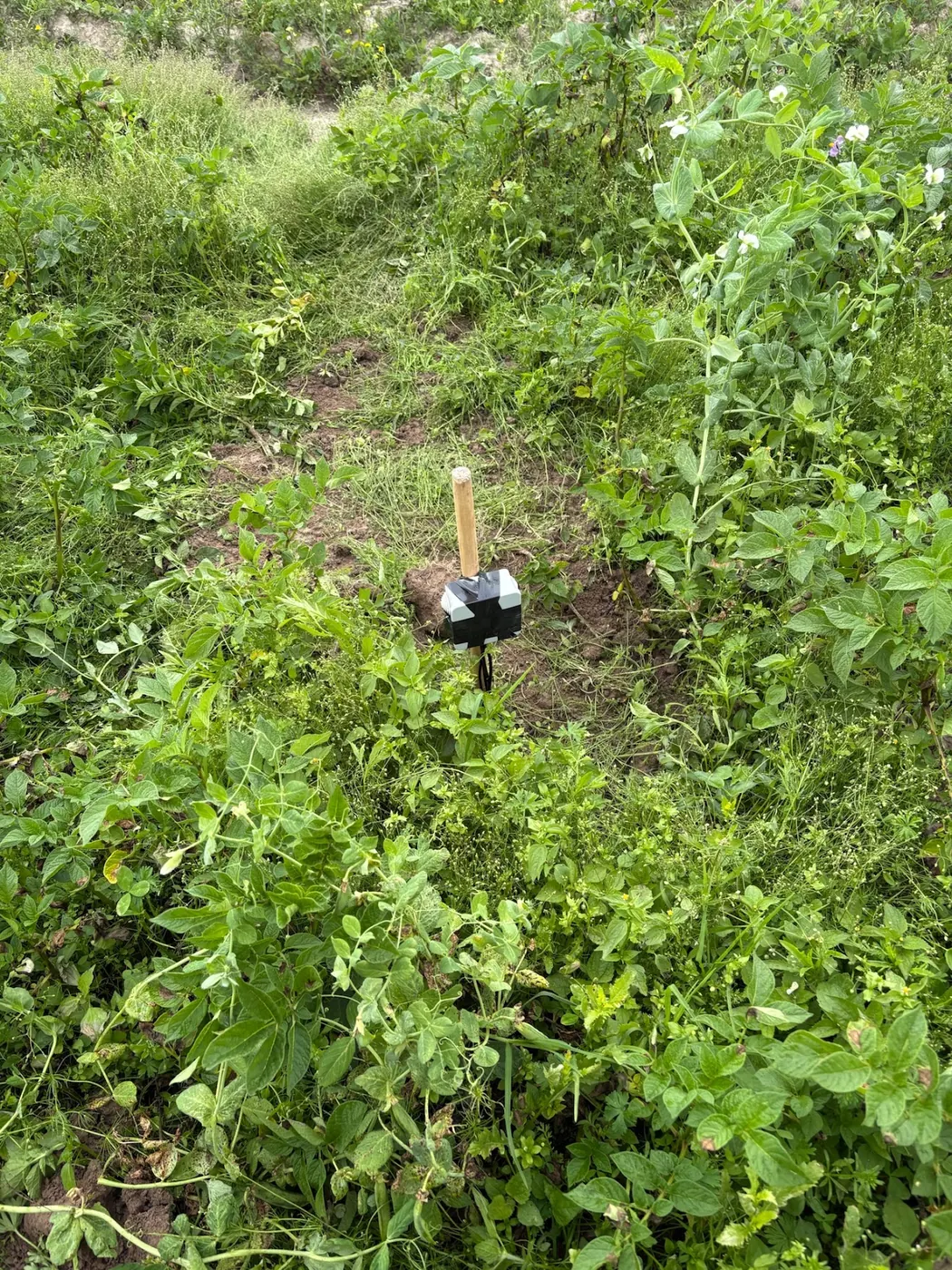
Back to the envelope. Arizona's guide puts a typical sensor's volume of influence at 0.1 to 1.0 litres, and cites the Meter T12 as unusually large at 0.26 gallons. Think of a one-litre water bottle. That is the most ground involved, and a tenth of it on the smallest designs. Whatever fills that litre is what gets measured. If a wide hole is loosely backfilled, an air pocket can sit against the electrodes. It stores almost no charge, and the probe reports dry soil that may be soaking wet a hand's width away. The same guide names air gaps around an installed sensor as a cause of faulty moisture and temperature readings. Disturbance at installation must be minimal, and the soil near the sensor preserved.
So installation outranks the electronics, and it is the part a grower controls most. Push a board straight into undisturbed, slightly moist soil and it stays in contact along its length. Force it into a dry crust and it cracks open a gap. Drop a cylinder into an auger hole and backfill with spoil, and it sits in crumbs that take weeks to settle; the trace drifts while they do. On depth, Arizona cites 6 inches (0.15 m) to 60 inches (1.5 m) as the most common installation range. That is a survey of what the market does, not a recommendation for a Kenyan bed. Our deployed sensors read at a shallow and a deeper probe, placed per installation by crop and rooting pattern, so there is no single figure to print. Find where the roots draw water, put the shallow probe there and the deeper one below it, and make the hole tight.
Organic ground is where the curve breaks first
Mineral-soil calibrations are the good news. The Frontiers handheld gave its weakest result on forest organic soil: RMSE 0.078 m3 m-3 and only moderate correlation, R = 0.80, more than double the generalised mineral error. Organic matter holds water in structures that do not present the same permittivity per litre as free pore water. Organic soils also have low bulk density, so a curve fitted on mineral soil assumes a relationship that ground does not follow.
Those were forest sites, not Kenyan ones. Nothing in this bank tested a capacitive probe on Kenyan organic ground. What can be reasoned is where the risk sits: beds heavy with manure or compost, peaty valley bottoms, highland ground built on years of residue. There, expect something nearer 0.078 than 0.035. On such ground, do not convert to litres unless you have fitted your own curve from that bed. Use the trace as a relative signal and anchor it with a spade. Our dashboard's soil baseline comes from iSDA Africa and SoilGrids, modelled values of around 2016 vintage and not a test of your field. It cannot know what you dug into bed six last season.
What to buy, and when the spade is the right call
Price ranges come next, then the cases where buying nothing is right. The Egyptian team built their own sensor because, in their words, commercial soil moisture sensors remain expensive for farmers in developing countries. AICCRA adds the regional detail: sensors used in Eastern Africa are typically manufactured in Southern Africa and are difficult and expensive to reach. That is in a region where less than five percent of cultivated land is irrigated, against a global average of thirty percent. Access is the bottleneck. By 2024, its programme had pushed over 87,000 sensors into more than 24 countries. But those were chameleon colour units, which show blue, green or red according to how hard roots must pull water from the soil. That is a tension measurement, not a dielectric one. Comparing it with a capacitive probe is comparing two different physical quantities.
Only our own prices get printed here: a soil sensor at KES 7,000, a two-moisture two-temperature variant at KES 9,000, an EC version at KES 10,000, and the weather station that carries their readings to the internet at KES 30,000, all excluding taxes. Agrovet board probes sit well below that. The gravimetric method costs a scale and an oven. Now the plain cases. Rain-fed, no pump, no tank: a probe gives you a number you cannot act on, so buy a rain gauge. One block you walk every morning on fine-textured soil: a tensiometer or your hand will serve. Scattered blocks, a remote pump, or a decision-maker who is not on the farm: the probe earns its place. The NuaSense overview of smart irrigation in Kenya covers how drip kits, solar pumping and soil sensors fit together on such a block. No source here mentions any regulator approving a soil probe, so treat a seller's certification claim as unverified until they show it.
How a capacitive probe fails in the field
Every failure in this instrument comes down to one link above it giving way, and the trace normally tells you which. If a reading drops sharply after installation and never recovers while the bed is visibly wet, you have an air gap. That litre around the electrodes is not soil. A reading that stays high and steady through a dry fortnight on a borehole-fed bed means salt is storing charge; put an EC meter in the same bed before you cut the water. When the shallow trace rises and falls each day and the deeper one stays flat, with no rain and no irrigation, heat is sitting on the sensor. Compare like hours to fix that one; don't try to correct it. A replacement probe that reads far off its predecessor in the same hole is the 0.045 unit-to-unit scatter, not a change in the soil, and the old threshold needs resetting. If a converted water content makes no sense on a compost-heavy bed, that is the organic case: the curve carried 0.078 of error on the ground it was tested on, and probably more on yours.
Two more failures fall outside the physics. The first is scale: a target band lifted from a paper lands on a dashboard with a different scale, so 46 percent of a sensor's range gets treated as 46 litres per 100. Then there is radio. Arizona's guide puts the average LoRa transmitter-to-station distance at about 1640 ft (0.5 km), with sensor-to-transmitter cables of 10 to 16 ft (3 to 5 m), batteries lasting 3 to 15 years depending on draw, and sampling intervals from 10 minutes to an hour. A probe placed out of reach fails silently and leaves a flat line that looks like stable soil. The probes here send roughly every 10 minutes over LoRaWAN to the weather station on the mast, so a gap in the record is a radio problem before it is a soil problem. Electrode pair, oscillator, voltage: they have done the same thing since the Institute of Hydrology built its probe. What fails is the soil contact, the curve, the salt, the heat and the assumption that a percent is a water content. Check those five, and the number on the phone tells you what it could always tell you: this litre of soil is drier or wetter than it was.