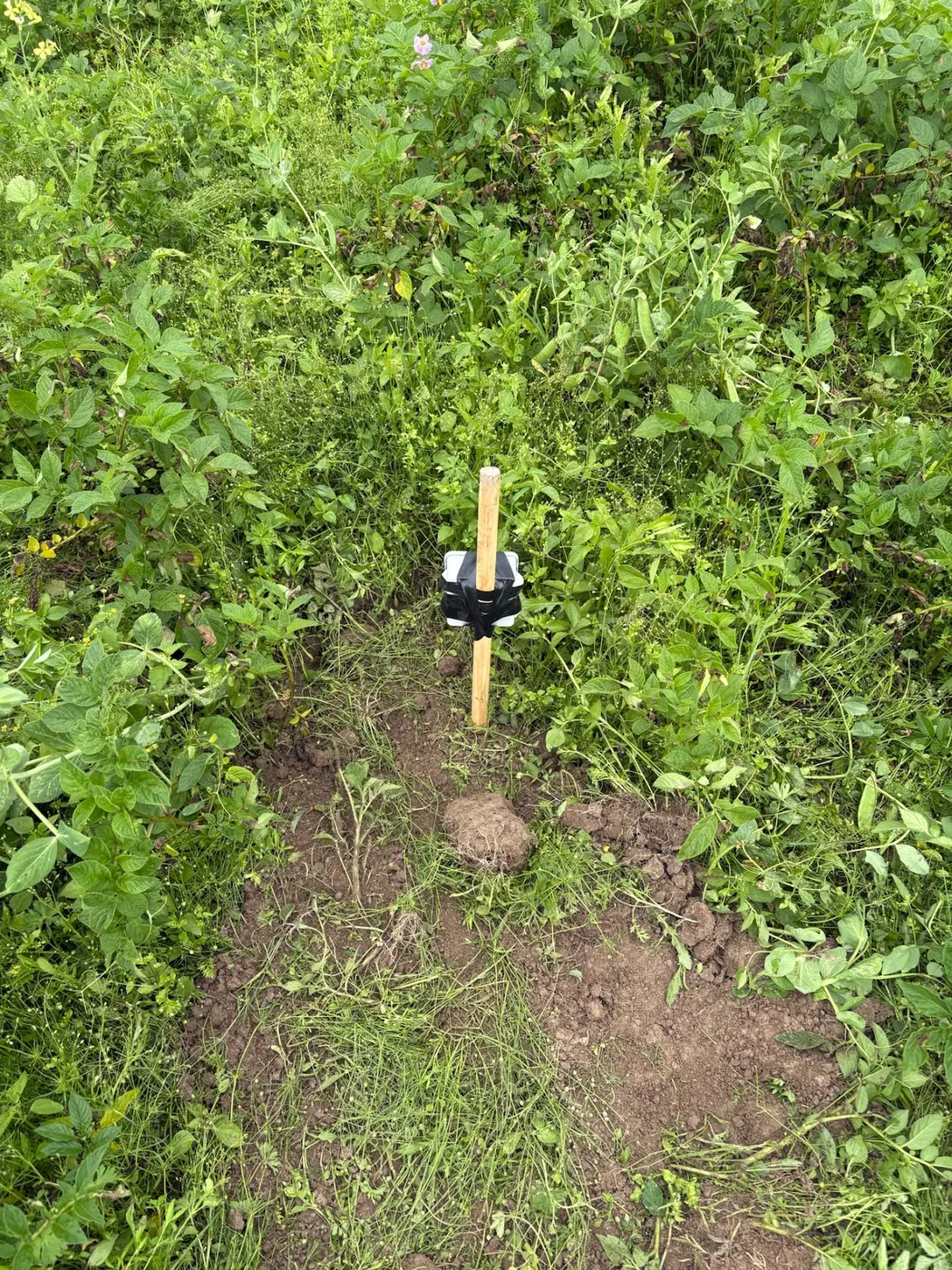
Somewhere on a Kenyan block right now, a labourer is cutting a furrow through standing water while the probe buried thirty metres away has already logged six readings showing the shallow depth pinned near the top of its scale, unmoving, for the better part of a day. Short rains waterlogging and disease pressure get treated as a drainage problem, and the furrow is the answer everyone reaches for. It works, eventually. The question the furrow never answers is how long the profile was already saturated before anyone picked up a hoe, and that gap, not the furrow, is what decides whether the crop comes out of the week intact.
Measured by NuaSense weather stations and soil probes on Kenyan farms, over the period stated with each figure. Past readings, not a forecast.
The furrow answers the wrong clock
A drainage furrow is judged by how fast the surface clears, and a well-cut one clears fast: an hour, maybe two, after the rain stops. That is the visible clock, the one a grower can watch. It is not the clock that matters to the root. A review of soil waterlogging mechanisms on PMC is specific about what actually damages the crop: it is oxygen deficiency caused by water saturation, not the water sitting on the surface. Soil pore space that would normally hold a mix of air and water fills with water alone once rain arrives faster than the profile can shed it, and the root loses its oxygen supply from the moment the pores fill, not from the moment a puddle becomes visible between the rows.
That means the furrow's clock and the root's clock start at different points and often end at different points too. A soil moisture sensor reading at the shallow probe tells you something the eye cannot: whether the profile below the surface is still saturated after the puddle has gone, because a shallow layer can drain visibly while water still sits lower down, held there by a compacted layer or simply by the volume involved. A grower relying on the surface look will call the field fixed the moment the furrow has done its visible job. The probe, checked at the same hour, may still show the shallow depth sitting high with barely any movement between ten-minute readings, which is the better indicator that the root is still short of air.
What the plant does while nobody is watching
Deprived of oxygen, root cells switch to anaerobic respiration, and that shift raises ethylene production inside the plant, the PMC review notes. A second review in Frontiers in Plant Science treats ethylene as the driver of the plant's actual response, not a side effect: it triggers programmed cell death in root cortex cells to build aerenchyma, air channels that carry oxygen down from the shoot, and it pushes the plant to grow adventitious roots nearer the surface where some air still remains. This is the plant's own engineering project, running underground while the field above looks ordinary.
None of that work is free. Energy spent building aerenchyma and new root tissue is energy the plant is not spending on grain fill, bulb bulking or fruit set, whichever the crop happens to be doing that week. A furrow that shortens the saturated period shortens how long the plant needs to run this workaround, and that is real value. It does not stop the workaround from starting, and it does not return the energy the plant already spent by the time the furrow finishes draining. The advice to drain fast is correct as far as it goes. It just answers less of the problem than growers assume, because the plant's response begins on the oxygen clock, not the surface-water clock.
A nutrient problem with the wrong name
Waterlogged soils develop deficiencies of potassium and calcium, the PMC review states, because the soil chemistry that keeps those nutrients available to roots depends on an aerated, oxidised environment that saturation removes. This produces a specific and common misdiagnosis. A crop that looks nutrient starved three weeks after a wet spell has drained does not necessarily have a fertiliser problem. It may be carrying the delayed cost of a saturation event that has already come and gone, and that a visual inspection after the fact will never connect back to the storm.
This is where a probe record earns its keep in a way a single field walk cannot. A grower who checks the plant three weeks later and sees pale leaves has no way, from that leaf alone, to tell whether the cause is a soil that genuinely lacks potassium or a root that has not yet recovered its capacity to take potassium up. Pulling the moisture record for the preceding month and finding a saturated stretch at the shallow probe gives a specific window to hold against the symptom. Reaching for a top-dressing bag on the leaf symptom alone, without checking whether a wet spell sits in the record, risks fertilising a soil that already has the nutrient, sitting in a form the root cannot use until it recovers.
Stage, not day count, decides the outcome
The trial literature is consistent on one point that the furrow-first framing ignores entirely: the same duration of waterlogging does very different damage depending on which growth stage it lands on. Maize is described in the PMC review as particularly sensitive at the three-leaf stage, with yield significantly reduced after as little as three days of saturation. A later study by Huang and colleagues, cited in the Frontiers review, found maize yield fell significantly only after ten days when tested at a different point in the season. In wheat, the same review places the worst window between the seventh leaf of the main stem and flowering, with tillering as a second vulnerable stretch, and losses climbing steeply once any stage runs past six days.
None of these day counts are Kenyan measurements, and none should be quoted as if a Kenyan variety on Kenyan soil will fail on exactly the same day. What transfers is the logic, not the number: a wet week landing at three-leaf stage is a different risk from the same rainfall landing on a crop past flowering, even when the gauge reading looks identical in both cases. A grower checking a rain total against the calendar and stopping there is skipping the one variable the research treats as decisive: which growth stage the water arrived at, not how much of it fell.
Onions collapse the drainage and disease decisions into one
Onions make the case that drainage and disease cannot be handled as two separate problems on some crops. They are shallow rooted and highly sensitive to waterlogging on their own, which already makes rainy season cultivation difficult, according to a study of concurrent waterlogging and anthracnose-twister disease published in Frontiers in Microbiology. The finding worth sitting with is that waterlogging and the anthracnose-twister disease complex act together, not as two risks that happen to coincide. Wherever rainy season onion cultivation is attempted, the paper reports, the disease complex shows up as a widespread obstacle.
That pairing changes the order of operations for anyone growing onions through the short rains. Fixing the water first and watching for disease symptoms afterward is already running behind the sequence the pathogen and the waterlogged root are running underground, together, from early in the wet spell. A grower who treats the furrow as the finished job on an onion bed, and only starts checking leaves for twisting or lesions once the water has visibly gone, is checking for a disease that had its opening a week earlier than the check.
Rice is not proof that water is safe. It is proof the rule is about the crop
It is worth naming the exception squarely, because it sharpens rather than undermines the rule. Controlled waterlogging in rice cultivation is beneficial, according to the MIT JO-CREWSnet overview of waterlogging and drought, because paddy crops are adapted to submerged conditions that suppress weeds and keep certain nutrients available to a flooded root. The same source notes that in drought-prone areas, temporary waterlogging can even bank water in the profile for later use, which cuts directly against the drain-it-fast instinct that governs every other crop in this piece.
What separates rice's tolerance from maize or onion's vulnerability is not the water itself, it is whether the crop evolved the aerenchyma and metabolic pathway to run on it as its default state rather than as an emergency workaround. A raised paddy bund and a raised maize bed can look like the same piece of earthworks from the edge of the plot, and they are solving opposite problems. A grower rotating rice with a dryland crop on the same ground needs to rebuild the bed for each rotation, not settle on one shape that compromises between the two.
A loss the probe cannot see either
There is a change happening below both the visual check and the moisture probe that neither will catch directly. A study on denitrifying bacterial communities published in Scientific Reports found that short-term waterlogging from rainfall shifts the composition of soil microbes that carry out denitrification, the process that converts soil nitrogen into gaseous forms that leave the field entirely. This is a microbial community shift, not a moisture reading, and it happens well before the crop above ground shows any visible stress.
A field that drained cleanly, with a moisture record showing the shallow probe back down within a normal range within a day or two, can still have lost nitrogen through a pathway that has nothing to do with runoff or leaching, the two losses growers usually picture from a wet week. There is no Kenyan measurement of how much nitrogen this costs on a smallholder block, and this piece will not manufacture one to fill the gap. What the finding argues for is moving the topdressing decision closer to the waterlogging event itself rather than to the calendar date originally planned, a question the earlier piece on soil moisture between land prep and topdressing works through in more detail.
Kenya's own record: a wet season lands on a debt, not a blank slate
The NDMA's 2024 short rains food and nutrition security assessment, covering 23 ASAL counties, is built explicitly to consider the cumulative effect of previous seasons and other shocks, not to score a single season in isolation. That framing is worth borrowing at farm scale even where the assessment itself operates at county scale and this piece will not stretch its findings down to a specific plot. A wet short rains season does not arrive on a field that is otherwise a clean baseline. It arrives on whatever the preceding long rains and dry spells already did to soil structure, nutrient reserves and crop stand condition, and judging the current season purely on its own rainfall total, the way a single-storm furrow decision does, misses that compounding.
This is also where the day-count trial figures earlier in this piece need their caveat restated plainly: none of them were measured in Kenya, on Kenyan soils, at Kenyan planting dates, and the honest position is that no equivalent Kenyan trial table exists to hand a grower here a day threshold for their own variety and soil. What a grower has instead is their own field's history, which a probe record keeps whether or not anyone thinks to check it until the crop shows a symptom worth investigating.
Reading the probe against the drainage decision
None of the trial evidence above tells a Kenyan grower the exact day their own maize or onion plot starts losing yield, because that specific trial has not been run on that soil, at that stage, in that county. What is checkable, and what none of the international figures replace, is whether the profile is actually saturated right now and whether that saturation is easing or holding steady, which is a different question from whether the surface looks wet. A shallow-probe reading pinned near the top of the scale with little movement between ten-minute readings is a closer match to the oxygen deficiency described throughout this piece than a glance at the field an hour after the storm.
The companion piece on what waterlogging actually does to yield inside the root zone works through the day-by-day tolerance figures in more depth, stage by stage, for a grower who wants that detail rather than the disease and nutrient angle this piece has taken. For the broader picture of which pests and diseases carry the largest cost across Kenyan crops generally, the overview of major crop pests and diseases in Kenya is the wider reference. The furrow still matters, and cutting it fast is still the right instinct. It is just the first decision in the week, not the only one, and the probe record is what tells you whether the second decision, on nutrients, on disease risk, on when to next apply nitrogen, is already overdue.