Begin with a contradiction. The top of a field may look dry while the soil deeper down never dries. Hardpan and compaction problems often announce themselves like this: the shallow probe falls after irrigation, the deeper probe stays high and flat, and the crop wilts on a reading that says water is plentiful. Our own network shows how flat a deep trace can be. Across 2 NuaSense probes between 04 September 2026 and 04 October 2026, soil moisture averaged 78 percent of sensor scale, and most readings sat between 72 and 86. That is percent of sensor scale, not volumetric water content. Some soils normally hold a narrow band like that. A layer that neither drains nor gets used would produce the same thing. The trace alone cannot tell you which one you have. This article explains how to tell.
Why the deeper probe goes quiet
The New Mexico State circular on compaction groups pores by size: macropores wider than 1 mm, mesopores from 0.01 to 1 mm, micropores narrower than 0.01 mm. Compaction usually removes the large and medium pores and leaves the small ones. Those consequences are physical, and they appear in a time series. When macropores are gone, the soil stays saturated for a long period, roots get no oxygen, and water can no longer infiltrate. Mesopores hold moisture for the short and long term. The circular notes that a compacted soil may still contain significant water, but much of it is held too tightly in the small pores to be available.
That second point is the one that fools people reading a probe. A high reading is not a statement that the crop can drink. Our probes report percent of sensor scale, so a high number says the soil is wet by the sensor's measure. It does not say the water is loose. If the deeper probe sits high and the crop is stressed, suspect that the water is there and unreachable, or that the roots never got down to it.
Two readings, then, should make you suspicious. A deeper trace that barely responds to a good irrigation or rain event. A shallow trace that spikes and falls fast while the deeper one stays level. Neither proves a pan. Both justify a spade.
What the pan is, and where it forms
The terms get muddled, so separate them. The UC Agriculture and Natural Resources guidance for Sacramento Valley field crops says a hardpan forms when the tillage implement presses the soil directly below it together, while deep compaction sits further down and comes from excessive weight on soil, particularly when it is wet. A North Carolina extension note from Randolph County describes a hard pan as a layer very few roots can break through, usually 1 to 2 inches thick, and says continuous disking or ploughing will make one develop just below the depth of the tillage.
The practical reading is that a pan has a depth, and the depth is set by what you pulled through the ground. Penn State extension reports plough pans on Pennsylvania dairy farms just below the working depth of a chisel plough, and says a moldboard plough with one wheel in the furrow compacts the subsoil directly. The Kenyan translation is a question about your own history: which implement, run at which depth, for how many seasons, and was the soil wet when it went through?
One excerpt from a CGIAR-hosted paper on conventional tillage reports compaction widespread at 20 cm because of a hardpan. The excerpt does not say where, so it cannot be taken as Kenya. Treat it as a reminder that the layer tends to sit near the working depth of the tools. On your farm, you can look that up rather than assume it.
The penetrometer and the spade
A probe trace raises the question. Mechanical resistance answers it. A penetrometer pushed steadily into the soil gives you resistance against depth, and a pan appears as a sudden rise. The USDA Agricultural Research Service paper on hardpan depth found the least variation in hardpan depth in trafficked row middles of a no-till field. That is a useful finding for how you sample: the depth of the pan is not one number for the field, and where you push matters.
The USDA conservation service summary of compaction symptoms describes compaction as higher bulk density and lower porosity caused by heavy loads on wet ground. It also lists lower infiltration, more runoff and roots that can't spread. You don't need an instrument to spot any of that. Dig a profile. The North Carolina extension guide on machinery says roots stop abruptly at a hardpan. The clearest sign is roots turning sideways or flattening at a single depth.
The research cited here gives no penetrometer resistance threshold for Kenyan soils, so we do not offer one. Use comparison instead. Push the penetrometer in a row middle. Push it in a headland that has seen more traffic. Then push beside a fence line that has seen none. That contrast tells you more than any absolute number.
Dig first, then read the trace against the hole
- Choose two spots a few metres apart in the same block, one in a trafficked track and one clear of it.
- Dig a profile with a spade and look for the depth at which roots bend, flatten or stop.
- Note the depth of your deeper probe against the depth of that layer. A probe sitting just under the pan reads a different soil from one sitting above it.
- Compare the deeper trace after rain or irrigation with the shallow one. Slow or no response at the deeper probe supports the digging.
- Repeat in a second block before you decide anything about the whole farm.
Probe depth needs care. NuaSense burial depth is picked for each installation, based on crop and rooting pattern. We publish no single centimetre figure. When a pan sits between the shallow probe and the deeper one, the pair works as a diagnostic: water leaves the top layer and never reaches the lower probe. If both probes sit above the pan, neither one tells you about it directly. In that case you depend on the shallow trace draining slowly instead. Our post on how to calibrate a soil moisture sensor against your own field explains how to find what a drained reading looks like in your soil. That baseline matters before any odd trace means anything.
What standing water is telling you
The Sacramento Valley account is a useful small example. About an acre of dry beans along a road were stunted where soil was heavily compacted and root growth was reduced. That stunted patch was also where water pooled during heavy rains. Healthy areas had no compaction problems. What you have, then, is a map of yield loss sitting on top of a map of ponding. That is cheap evidence. You can collect it by walking a field after rain.
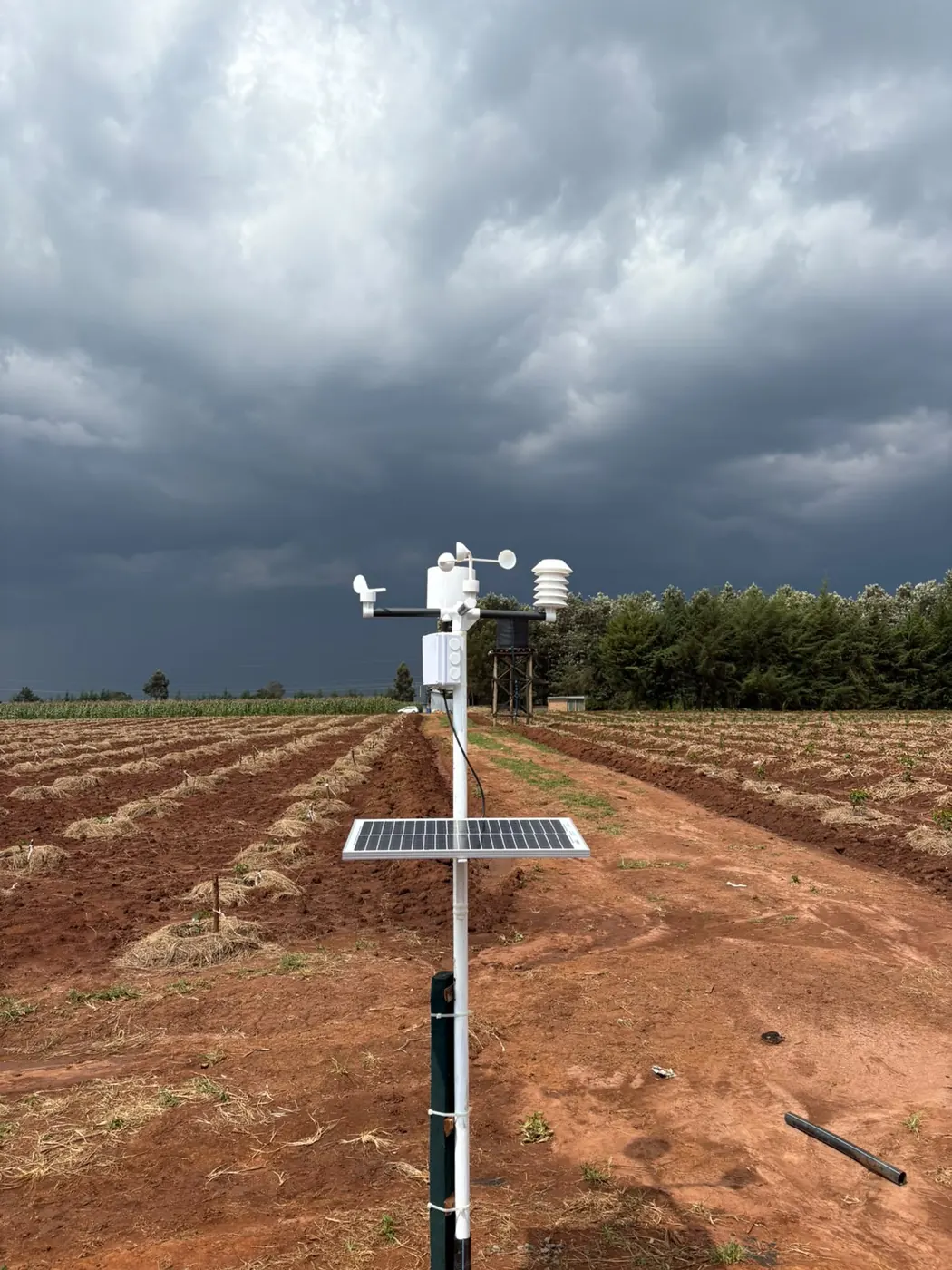
For rainfall context, our network recorded station totals from 0.4 mm to 68.9 mm across 4 stations between 04 September 2026 and 04 October 2026. Only 144 of 10,207 ten-minute readings (1.4 percent) carried any rain. The stations are not co-located, so this is a spread, not a regional figure. The point for you is that a month with little rain gives you few chances to watch water pond. Long-term October rainfall in the grid cells where our stations stand averaged 61 mm over 43 years of CHIRPS. Extremes ran from 20 mm in 1996 to 290 mm in 2019. That satellite-and-gauge product is not our gauge, but it shows how widely October can swing. A wet October is when a pan shows itself.
We do not forecast, so this is not a prediction. It is one reason to keep your own rain record and your probe traces side by side. Then when a heavy event arrives, you can see how the deeper probe responded.
The water bill and the yield bill
The cost comes in two parts. On water, the NC State guide says hardpans are especially harmful in dry years. They limit the crop's access to water and nutrients. Penn State research backs this up in a strange way. Compaction caused a 30-bushel yield decrease in the dry year of 2002, and a 20-bushel loss in the wet year of 2003. The loss was larger in the dry year. Those are bushels from a Pennsylvania trial, so do not move the number to a Kenyan crop. Move the pattern: a pan costs most when the crop needs to reach deeper water.
Yield losses cover a wide range. Penn State reports annual alfalfa losses up to 37 percent from normal traffic in Wisconsin and Iowa. A multistate project found 1 to 34 percent. An international effort that included tillage after compaction found average first-year losses of about 15 percent. Those fell to about 3 percent ten years on without recompaction. The remainder was most likely subsoil compaction considered permanent. In Kentucky, corn on extremely compacted no-till soil reached only 2 percent of uncompacted yield in the first year. It recovered to 85 percent in the second and stabilised near 93 percent.
Not one of these figures comes from Kenya. Read together, they say losses can be small or severe. They shift with soil, season and history, and recovery takes time. So if anyone gives you one fixed yield penalty for hardpan on your farm, they made it up.
Western Kenya's answer was biological
Only one East African study appears in the evidence, and it didn't measure hardpans. The ILRI trial on reducing soil erosion in smallholder systems in East Africa looked at five treatments in western Kenya: a maize and common bean intercrop; the same intercrop with Calliandra hedgerows and mulch; lablab alone; mucuna alone; and groundnut intercropped with maize in the short rains. What it recorded was runoff, erosion, infiltration, earthworms, biomass and grain yield. It did not record pan depth or yield loss from compaction.
Still, it points to the same mechanism. Calliandra had the lowest runoff (11.6 to 17.2 mm per hectare) and the lowest soil erosion (31 to 446 kg per hectare per season) in every season, with mucuna next. Infiltration was highest under Calliandra. Earthworm counts were higher under mucuna and Calliandra (229 and 165 per square metre) than under the other crops. Lablab got disease and had the highest erosion in the last two seasons.
The reading here is inference: when water runs off instead of infiltrating, one cause is a surface that has lost its pores. Roots and worms made the channels in the treatments that kept infiltration up. That is the opposite of steel. It is slower. It needs a rotation or a hedgerow on your land, and it does not fix a pan you already have. It is also the approach that needs no tractor.
Ripping: when it helps and when it does not
The North Carolina guide calls ripping the best way to break a hard pan. It then adds a caution: ripping does not always improve yield, and you should only do it on soils with high bulk density and high penetration resistance in the sublayer. The UC guidance says ripping or chiselling can help the current season, but not soil structure over time. It also says gypsum cannot reduce compaction of an existing hardpan. Randolph County extension says deep tillage can break up hardpans, but its yield effect is variable.
So the order matters. Diagnose first, using the penetrometer and the profile. Then rip only the zones that earn it. The spatial finding from the ARS paper backs this up: if pan depth varies, one ripping depth across the field will miss some of it and waste diesel on the rest. Zone-by-zone work is more fuss. It is also more honest about what you know.
Never rip wet soil. The way compaction happens is heavy loads on wet soil. If you put the same loads on the same wet soil and call it repair, you repeat the problem. Penn State's alfalfa data shows the timing effect: damage to stands was greater 5 days after cutting than 2 days after cutting, presumably because the soil was wetter at one time than the other.
No-till, and the argument over it
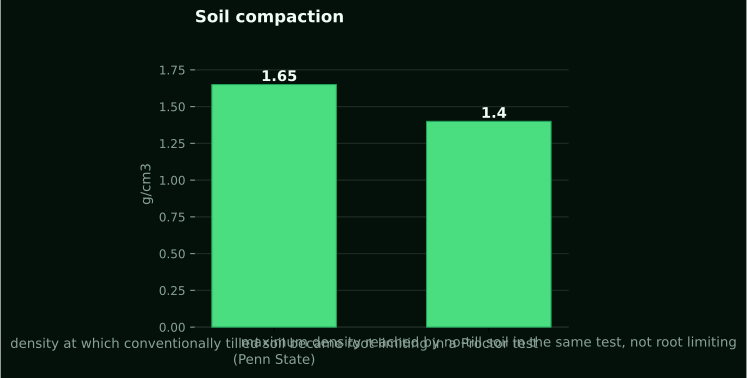
The evidence here is messy. In the Penn State Proctor test, conventionally tilled soil could be compacted to 1.65 g/cm3, which is considered root limiting. No-till soil only reached 1.40, which is not. No-till soils generally have more organic matter, better structure, and balanced air and water. Yet the NC State guide says no-till cannot eliminate a hardpan. Its North Carolina example formed after 25 to 40 years of no-till, compared with three to four years for a much harder layer under conventional management.
Both claims stand. No-till slows compaction and takes the edge off it. It won't make your field immune, and one management strategy can't wipe out compaction. Penn State notes that subsoil compaction lies below the depth of normal tillage, and wetting and drying won't relieve it on any soil type.
For a Kenyan manager, one plain fact limits how far this transfers: the measurements came from temperate soils and mechanised equipment. This evidence doesn't answer whether a hand-hoed block builds a pan at the hoe depth. Dig and see.
Traffic, tyres and the first pass
Most compaction happens on the first pass of machinery, NC State says. That changes how you see the problem: cutting the number of passes helps less than cutting the damage from each pass. Their recommendations: control traffic, match tyre widths so each pass compacts the same soil, stay off wet soils, keep tyre pressure right, and keep axle loads under 10,000 lb to stop sub-horizon compaction. Penn State says subsoil compaction effects come from axle loads of 10 tons and heavier on wet soil, in all soil types including sandy ones. Randolph County adds that higher tyre pressure compacts deeper, while wider tyres or more tyres lower the pressure at the surface.
NC State also admits controlled traffic may not be practical until every farm has the technology. That goes double when the machine is a hired tractor that shows up when its driver can reach you. You may not choose the tyres. You can choose the day. You can choose the headland where it turns.
Surface crusting is a different problem. The NMSU circular describes it this way: raindrops, runoff, standing water in irrigation or tillage break down aggregates, and a thin dense layer forms. That layer restricts water and air entry and impedes seedling emergence. If your seedlings struggle while your penetrometer reads fine below, that is the culprit.
What a pan does to roots, in a pot
A paper in AGRIS describes a pot method that simulates a hardpan using a thin layer of paraffin wax and petroleum jelly in a soil column. The study ran five experiments. Two were well watered and three were under drought. It used 24 Australian wheat cultivars and breeding lines. Eight entries penetrated well in both conditions. Roots of three other entries that failed to penetrate the wax died under drought. The reason for the work: in south-western Australia, a significant share of arable land is highly susceptible to subsoil compaction, and that limits wheat roots' access to water and nutrients at depth.
This is a pot, wax and wheat. It says nothing about Kenyan varieties. What it does show: damage is worst when drought and a pan coincide, and genetics may help at the margin. That belongs to crop choice. It is a topic for our sister site on farming practice, not here.
What to change on Monday
- Pull the last month of deeper-probe traces and mark the blocks where it barely moves after irrigation or rain. Those are your first digging sites.
- Take a spade and a hand penetrometer, if you can borrow one, to a trafficked row middle and an untrafficked edge, and compare.
- Write down which implement ran at what depth on those blocks. The pan will be just below it.
- Hold machinery off wet blocks, and hold any ripping until you have a diagnosed zone to rip.
- If the pan sits between your two probe depths, leave the pair where it is. It is now your before-and-after record.
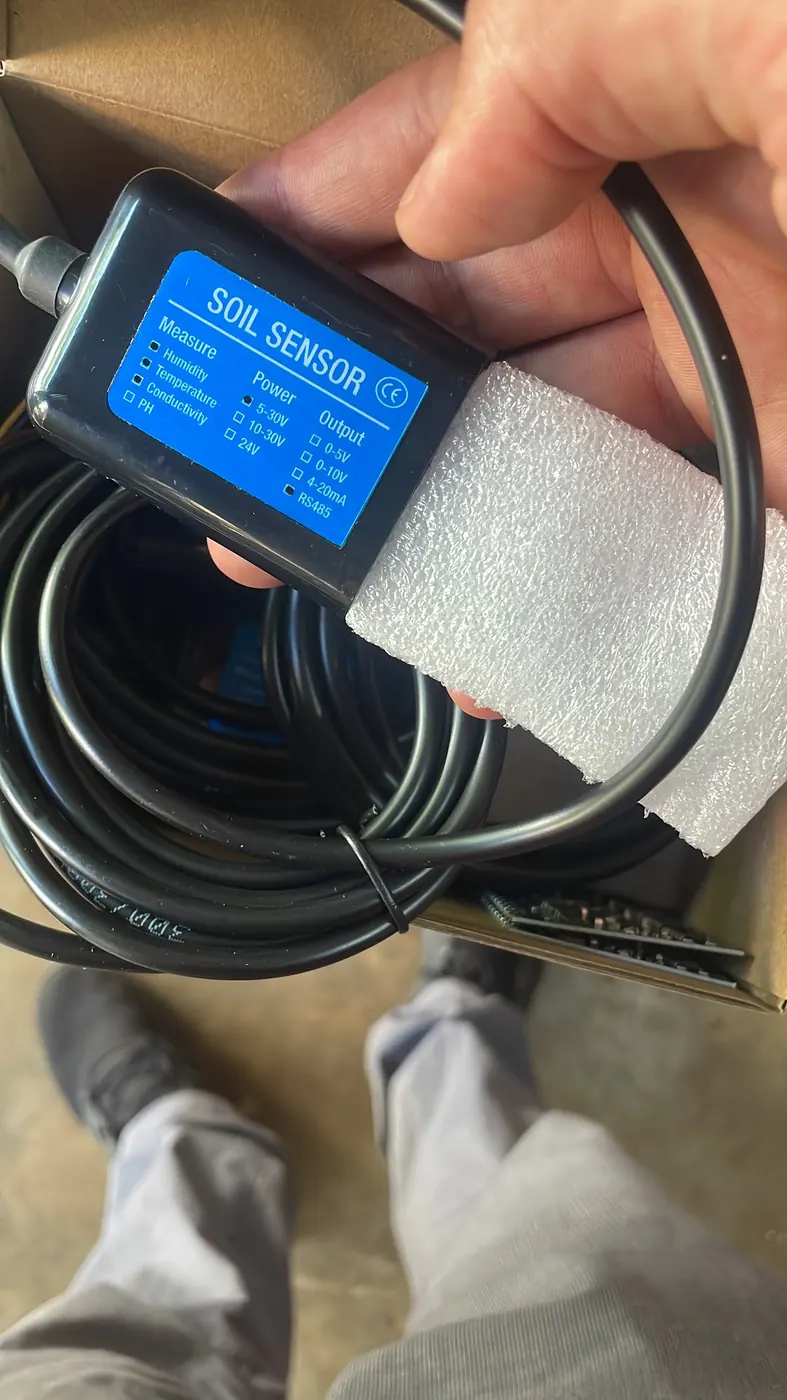
If you're weighing sensors, a soil sensor costs KES 7,000 and a weather station costs KES 30,000, both excluding taxes. The soil moisture sensors page explains the two-depth design. A probe won't find a pan. It tells you where to dig, and that is most of the job.
For more on field sensors, NuaSense has a longer article: IoT applications in Kenyan Agriculture. It looks at what works for smallholder farmers, smart irrigation, pest and soil monitoring, and ways sensors can cut input costs.
Also drawn on for this piece: Genotypic differences in root penetration ability of wheat.