The Daily Nation report on drought-hit farmers hesitating to replant names a real hesitation, but it does not name the decision underneath it. A farmer standing on a burnt maize field in early September is not really choosing between replanting and giving up on the crop. The retreat, if there is one, is happening field by field, and it hinges on something almost nobody in western Kenya has ever done: found out what is actually wrong with the soil under the dead crop.
Measured by NuaSense weather stations and soil probes on Kenyan farms, over the period stated with each figure. Past readings, not a forecast.
The choice a burnt field actually presents
Three things can be true about a maize field that failed this season. The rain genuinely did not come, in which case replanting the same seed into the same soil is a bet on the next rains, nothing more. The soil could not hold what rain did fall, in which case seed choice will not fix it. Or the crop was starved of a nutrient the fertiliser bag never supplied, because the fertiliser recommendation was blanket rather than field-specific. Only the first of these is a weather problem. The other two are soil problems, and they do not announce themselves. A field can look identical to its neighbour and behave completely differently underneath, which is exactly the finding behind soil acidity mapping in western Kenya.
This is where the replant decision actually splits. Replanting without any diagnostic step assumes the field is fine and the season was not. Getting a soil test before replanting assumes the opposite: that the field itself needs answering. Both cost something. Both cost time you may not have before the next planting window. The Nation's framing, wary farmers, treats hesitation as the problem to solve. It is closer to the correct instinct than confidence would have been, because confidence without a soil answer is exactly what produced the failed crop in the first place.
Why the fertiliser bag stopped working
Kenya's fertiliser use has grown steadily since the 2006 Abuja Declaration on Fertiliser for Green Revolution, yet maize yields have stagnated and in places declined, according to the western Kenya soil-testing study published in Frontiers in Sustainable Food Systems. The study attributes that stagnation to unresponsive soils, poor soil health, acidity, nutrient imbalances, and continued use of blanket fertiliser recommendations that ignore how much soils differ from farm to farm. That last point matters more than it sounds. A blanket recommendation is written for an average field. Half the fields it is applied to sit below that average and get too little of what they need, the other half sit above it and waste money on nutrients already present.
None of this shows up as a visible symptom you can diagnose by looking at a wilted plant. Acidity locks up phosphorus in a way that mimics drought stress: the plant looks starved of water because it is functionally starved of a nutrient it cannot take up. A farmer who replants the same variety with the same fertiliser rate onto acidic ground is repeating the exact input mix that failed, and blaming the rain for a result the soil chemistry had already decided. This is precisely why the four counties in the study, Bungoma, Kakamega, Trans Nzoia and Uasin Gishu, were selected: government testing under the National Accelerated Agricultural Inputs Access Program had already flagged them for high acidity, well before this season's dry spell arrived.
The information gap that decides the decision
Here is the number that should reframe the whole conversation. In that same four-county study of 1,592 smallholder maize farmers, fewer than 8 percent had ever conducted a soil test on their farm, and only about 7 percent knew where to obtain the service at all. That is not a farmer failing to act on information. That is a service most farmers cannot locate. A logistic regression across the sample found that access to extension, the age of the household head, group membership, awareness of where to test, land size, perceived soil fertility and the number of economically active household members all shaped whether testing happened, with extension access, household head age and group membership significant at the strictest threshold the study used.
That list is worth reading slowly, because it tells you the testing decision is not really about willingness. It is about whether a farmer belongs to a group, has extension contact, or happens to live near a lab. A farmer with the money for a soil test but no route to one is in exactly the same position as one who cannot afford it. This is the honest limit of any advice that says test your soil first: it is correct, and it is currently out of reach for the large majority of the growers the study covers. Soil testing itself does not raise yield or fertiliser efficiency directly, the study is explicit about that: it generates information for site-specific management. It is a diagnostic step, not a fix. Its value depends entirely on whether the result can be acted on.
Weighing replant now against wait and test
Laid out plainly, the choice facing a farmer on burnt ground has three real paths, and each has a cost and a return that has nothing to do with hope.
- Replant immediately with the same seed and fertiliser rate: costs only the seed and labour you already budgeted, buys nothing new, and repeats whatever caused this season's failure if the cause was soil rather than rainfall.
- Delay planting to pursue a soil test: costs the planting window itself, which in a rain-fed system can mean missing the rains entirely, but buys a pH and nutrient reading that tells you whether lime or a different fertiliser blend, not a different variety, is the actual fix.
- Replant now but change the input mix based on visible field history, such as known low-lying acidic patches or land that has never responded well to fertiliser, without a formal test: costs nothing extra up front, buys a partial correction, and risks guessing wrong in the same way blanket recommendations already guess wrong.
None of these is free of risk, and none is obviously correct for every field. A farmer with land in Bungoma or Uasin Gishu, where acidity has already been mapped at the county level, has more reason to suspect the soil than a farmer on a field with no known acidity history. That county-level signal, even without a fresh test, is worth more than a guess.
What the seed aisle can and cannot fix
A parallel temptation is to treat the replant decision as a seed decision: buy a newer, supposedly hardier variety and assume that solves it. Kenya's maize seed market is dominated by Kenya Seed Company, with around 20 companies now operating and roughly 80 percent of seed coming through formal channels, according to the study of Kenya's maize seed sector. That same study looked for evidence that Kenya Seed Company's dominant position amounts to regulatory capture and could not establish it in the substance of the seed laws, though it did find procedural problems that smaller and multinational companies felt more sharply than Kenya Seed Company did. The study frames varietal turnover, the replacement of older germplasm with newer material, as important for climate adaptation, and argues that weak competition slows that turnover down.
What this means for a replanting decision is narrower than it sounds. A newer variety may carry better drought tolerance bred in since the variety currently on most farms was released, but the seed sector study gives no yield figure, no drought-tolerance percentage, and no cost comparison to attach to that claim, so none should be invented here. The honest version is procedural: seed-sector friction slows down how fast better genetics reach the shelf, which matters for the market as a whole, but it does not tell an individual farmer standing at an agrovet counter today which bag to buy. That question, stay with your current variety or switch, is worked through in a companion piece on which maize seed to buy this season, and it deserves to be read on its own rather than folded into a soil decision it is not equipped to answer.
What a long trial record says about a single bad season
IITA's international maize trial archive for Kenya runs from 1989 to 2015, spanning more than thirty African countries and explicitly recording drought stress alongside borer and striga attack, with support from the Bill and Melinda Gates Foundation and USAID. A dataset of that length exists precisely to answer a question a single dry season cannot: whether a bad year is an anomaly or a pattern. The archive does not hand a farmer a number to plug into this year's decision, and none of the figures released alongside it belong in a claim about this season's yield. What it does support is a more modest and more useful point: judging one field in one drought year against thirty years of trial data is a different exercise from judging it against last season alone, and a farmer's own instinct that this year was unusually bad deserves to be checked against a longer record before it becomes a permanent judgment on the field.
The same caution applies to a related study cited in that archive, on drought-tolerant maize varieties and adaptation strategies, published in the Journal of Environmental Management. The excerpt available here gives the title, journal and page numbers only, with no result figure. It would be easy, and wrong, to attach a yield-gain percentage to that title because the subject sounds like exactly what a drought-hit farmer wants to hear. Resist that. The correct use of a source you cannot fully read is to name what it studies and stop there.
What conditions actually looked like this season
Across NuaSense's own weather station network, 11 stations recorded air temperatures between 3.7 and 31.6 degrees Celsius over the month from mid-August to mid-September 2026, with a mean of 17.8 degrees, and mean humidity of 71 percent. Rainfall told a sharper story: station totals over the same period ranged from zero to 73.1 millimetres across eight stations, a spread between individual sites rather than a single regional figure, since the stations are not co-located. Only 1.6 percent of all ten-minute readings across the network recorded any rain at all. Reference evapotranspiration averaged 1.4 millimetres a day across six stations, a demand figure, not a crop water-use figure, and it kept pulling moisture out of soil that was barely being replenished.
Set against the CHIRPS satellite rainfall record for the grid cells these stations sit in, September has averaged 35 millimetres across 43 years of data, ranging from a driest 5 millimetres in 1997 to a wettest 79 millimetres in 2020. That range is wide enough that a farmer cannot read this season's shortfall as proof of a changed climate from the number alone; it sits inside a swing the record has produced before. What it does confirm is that the dry stretch behind this replant hesitation is not imagined. Soil probes across the network averaged 70 percent of sensor scale over the same period, with most readings between 19 and 89 percent, and soil temperature averaged 17.2 degrees. These are aggregated across our own probes, not a reading from any single named farm, and they describe the period that has just passed, not a forecast of the one ahead.
Where a field record actually helps
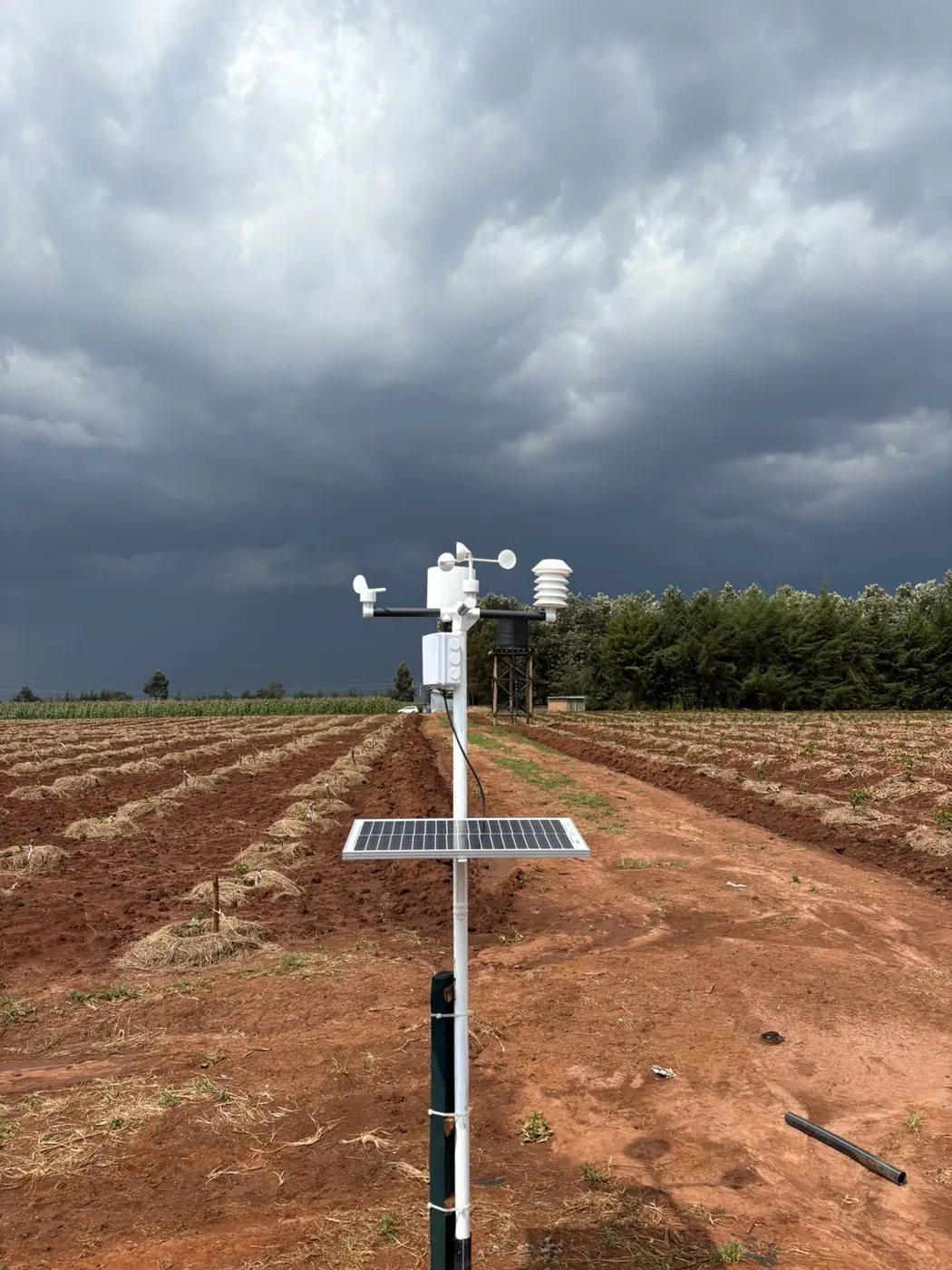
A soil test answers a chemistry question: is the field acidic, is it short of a specific nutrient, does it hold organic matter at a level that supports the crop. A moisture record answers a different question entirely: did the field actually dry out to the point of stress, and when. A farmer who cannot get a lab test this month, which the Frontiers study suggests describes the overwhelming majority, can still put soil moisture sensors into a field and get an honest answer to the second question within days. That does not replace the diagnostic value of a pH reading. It does tell you whether replanting into the same conditions this month is likely to meet the same dry stretch that killed the last crop, or whether the soil has since recovered enough moisture to carry a new planting through establishment.
This distinction also bears on how water reaches the root zone once rain does return. A field that sheds water rather than absorbing it will punish a replant decision regardless of what the seed bag or the soil chemistry says, and working out whether that is happening on a given field is a separate measurement from either soil testing or moisture monitoring: it is an infiltration measurement, covered in a piece on why irrigation run times go wrong without a measured infiltration rate. None of these three measurements substitutes for the others. A farmer choosing between replanting now and waiting is really choosing which of three separate uncertainties, chemistry, moisture, and infiltration, they are most exposed to on their particular field, and none of them can be resolved by watching the sky.
The extension and group-membership route worth pursuing
The Frontiers study's finding that extension contact and group membership were the two strongest predictors of soil testing, both significant at the strictest level used, points toward a route that costs less than a private lab fee. A farmer belonging to a cooperative or a registered farmer group in Bungoma, Kakamega, Trans Nzoia or Uasin Gishu has meaningfully better odds of being connected to a testing service than one farming alone, independent of land size or wealth. That is a structural finding, not encouragement: it says the fastest way most smallholders in these counties will reach a soil test is through a group they already belong to or could join, not through seeking out a private lab on their own. A separate study of maize-legume smallholders in Embu and Siaya, using a three-wave panel survey, found that extension contact, labour availability, household wealth and education level all positively drove adoption of sustainable intensification practices, while insecure land tenure and poor soil quality worked against it. The geography differs from the acidic-soils counties, but the mechanism repeats: contact with extension changes what a farmer is able to do with a bad field, more reliably than the farmer's own resolve does.
Trials on organic and mineral fertiliser combinations in Kenya's central highlands, established in 2004, sit in a different agroecological zone again, a reminder that a fertility fix proven in Nyeri or Murang'a is not automatically the fix for acidic soils in Trans Nzoia. The transfer has to be made deliberately, county by county, not assumed.
What NuaSense measures and does not decide for you
A weather station and a soil probe network cannot tell a farmer whether their field is acidic. That is a chemistry question a lab answers, and the honest gap in this whole discussion is that the overwhelming majority of maize farmers in the four counties studied have no route to that answer this season. What the network can do is remove one layer of guesswork from the replant timing itself: whether the field has actually rewetted enough to support germination, whether leaf-wetness hours (26 percent of station-hours over the past month, roughly 6.2 hours a day on average) are running long enough to raise disease risk once rain does return, and whether vapour pressure deficit, which averaged 0.83 kPa and peaked at 3.32 kPa over the same stretch, is pulling moisture out of young plants faster than the soil can replace it. These are measured conditions, not predictions of what comes next, and NuaSense does not forecast rainfall or issue a seasonal outlook. A broader look at how Kenya's shifting rainfall and temperature patterns are already reshaping maize, tea and coffee production covers the longer trend behind seasons like this one, if the country-level picture is what you are after rather than the field-level decision.
The replant decision itself does not resolve into a single rule. A farmer on land with a known acidity history and access to a group or extension contact should pursue a soil test before replanting, even at the cost of a delayed planting window, because the study's own framing is clear that testing generates information rather than yield, and that information changes which input to buy, not whether to farm the field at all. A farmer without that access is not wrong to replant on the evidence available, provided that evidence includes an honest read of whether the soil has actually rewetted, not just whether it has rained somewhere nearby.
The decision to carry into next season
None of this converts into a single sentence a farmer can act on tomorrow morning, and that is closer to true than a tidy answer would be. What can be said plainly is that the drought behind this week's headline is real, measurable in a network that recorded rain in only 1.6 percent of its readings over the past month, but it is not the only variable deciding whether a replanted crop succeeds. Soil chemistry that almost no smallholder in western Kenya has had tested, a seed sector where turnover is slower than climate adaptation needs, and a moisture record that a farmer can now check without waiting for a lab, all sit between this season's failure and next season's outcome. Replanting without any of that information is still the default for most growers, because the alternative, waiting for a soil test, is currently out of reach for the large majority the research describes. That gap, not the drought itself, is the more useful thing to have learned from this week's reporting.
Also drawn on for this piece: Grain Yield and Other Agronomic Traits of International Maize Trials; Maize-legume cropping system: Insights from Smallholder Farmers in Kenya; Enhancing Maize Productivity and Profitability.